You've paid for a car in Japan, the vessel is booked, and now a new question lands. What will the Road Transport and Safety Agency (RTSA) charge when the car reaches Zambia, and what paperwork will it want to see?
This guide pulls out the fees RTSA lists for first registration, explains each document in plain language, and then says clearly what those fees leave out. It also covers the Zambia Revenue Authority (ZRA) and Zambia Police steps.
Quick Answer
- RTSA's registration page states "Payable Fee is K238" for first registration (checked 16 November 2026). Fees can change, so confirm with RTSA.
- The registration page lists K200 for the Interpol clearance certificate, which Zambia Police issue. The K64 physical inspection fee is listed on the same RTSA registration page.
- The three listed fees come to K502. That is not the full cost of registering an imported car.
- RTSA asks for a ZRA Customs Clearance Certificate before it registers the car. Clear customs first.
- You, or your clearing agent, handle clearance and registration. The exporter in Japan does not.
What does RTSA charge to register an imported car?
RTSA's Vehicle Registration page, checked on 16 November 2026, states "Payable Fee is K238" under first registration and lists K200 for the Interpol clearance certificate. The K64 physical inspection fee is listed on the same RTSA registration page.
The page is undated, and fees can change.
Confirm the current amounts with RTSA before you pay anything, either through the RTSA registration page or at a registration office.
RTSA fees at a glance
The table below shows each listed fee and the sum of the three.
| Item |
Fee listed by RTSA |
What it is for |
| First registration |
"Payable Fee is K238" |
First registration of the vehicle |
| Physical inspection |
K64 |
RTSA's physical inspection of the car; fee is listed on RTSA's registration page |
| Interpol clearance certificate |
K200 |
The Zambia Police clearance certificate; listed on RTSA's page, issued by Zambia Police |
| Sum of the three listed fees |
K502 |
Not the full cost. Duty, port charges, road tax, plates, insurance and transport are extra |
 Illustration: A blank three-row checklist, calculator and pen on a wooden desk.
K502 is a planning number for the RTSA counter and nothing more. The bigger bills, customs duty above all, sit outside it.
Which documents does RTSA ask for?
RTSA wants proof that the car has cleared customs, passed a police check, been physically inspected and is insured, plus your identity document. ZamPortal, the Zambian government's electronic services portal, confirms five of those items for RTSA registration. RTSA's own registration page also lists several ZRA forms.
Here is the full checklist, with one plain line on each item:
- ZRA Customs Clearance Certificate. The document ZRA issues once import duty has been assessed and paid. Confirmed on ZamPortal. RTSA won't register the car without it.
- ZRA receipt. Proof of payment for the customs assessment. ZamPortal lists it for the Interpol application.
- Release order. A ZRA document releasing the car from customs control. ZamPortal lists it as "obtained from ZRA" for the Interpol step.
- CE 20. A ZRA customs declaration form listed on RTSA's registration page. ZamPortal doesn't mention it, so ask RTSA or your clearing agent exactly which copy they want.
- Interpol clearance certificate. Issued by Zambia Police. ZamPortal confirms the document is required, but it doesn't describe what the check covers.
- Physical inspection report. The RTSA inspection record, also confirmed on ZamPortal.
- Insurance cover note. A valid cover note is a listed requirement. This article gives no insurance amounts.
- Your ID. A copy of the identification of the owner or importer.
- Forms CNV1 and RL3. RTSA forms listed on RTSA's registration page. ZamPortal doesn't list them, so treat them as RTSA's to confirm.
 Illustration: A ticked checklist, document folders and an envelope arranged on a desk.
The Interpol application itself has a longer list. ZamPortal shows it needs the ZRA receipt, supplier invoice, release order, both RTSA and Interpol physical inspections, the Japanese export certificate, a ZRA evaluation paper, the Customs Clearance Certificate, the bill of lading and your ID.
You can cross-check the registration list yourself on ZamPortal's vehicle registration page.
What does the Road Traffic Act 2002 say?
The Road Traffic Act No. 11 of 2002 is the law behind the RTSA counter. Its section 10 is headed "Requirements for clearance of motor vehicle", and section 11 is headed "Registration of motor vehicles and trailers". The headings point to clearance first and registration second.
 Illustration: An open book, reading glasses, a pen and a Zambian flag pin on a desk.
You can read the full text in the Road Traffic Act PDF hosted by RTSA. The practical order holds: clear customs, then Interpol, then register.
What does K502 not cover?
K502 covers only RTSA's three listed items. It leaves out customs duty, port clearance charges, road tax, number plates, insurance and inland transport.
Customs duty is the biggest gap. ZRA assesses it based on engine capacity, vehicle age and Zambia's current import rules. The amount changes with the schedule in force, so no fixed figure belongs in an evergreen article. For how the assessment works, and which export documents you'll need, see Carbarn's Zambia import rules and regulations page and the import cost and port routes guide.
The other items stack up around registration:
- Port clearance charges at Dar es Salaam, plus any clearing agent's fee.
- Inland transport from the port overland into Zambia.
- Road tax, which ZamPortal lists as a separate RTSA step after registration.
- Number plates and the registration card.
- Insurance, which you need before RTSA registers the car.
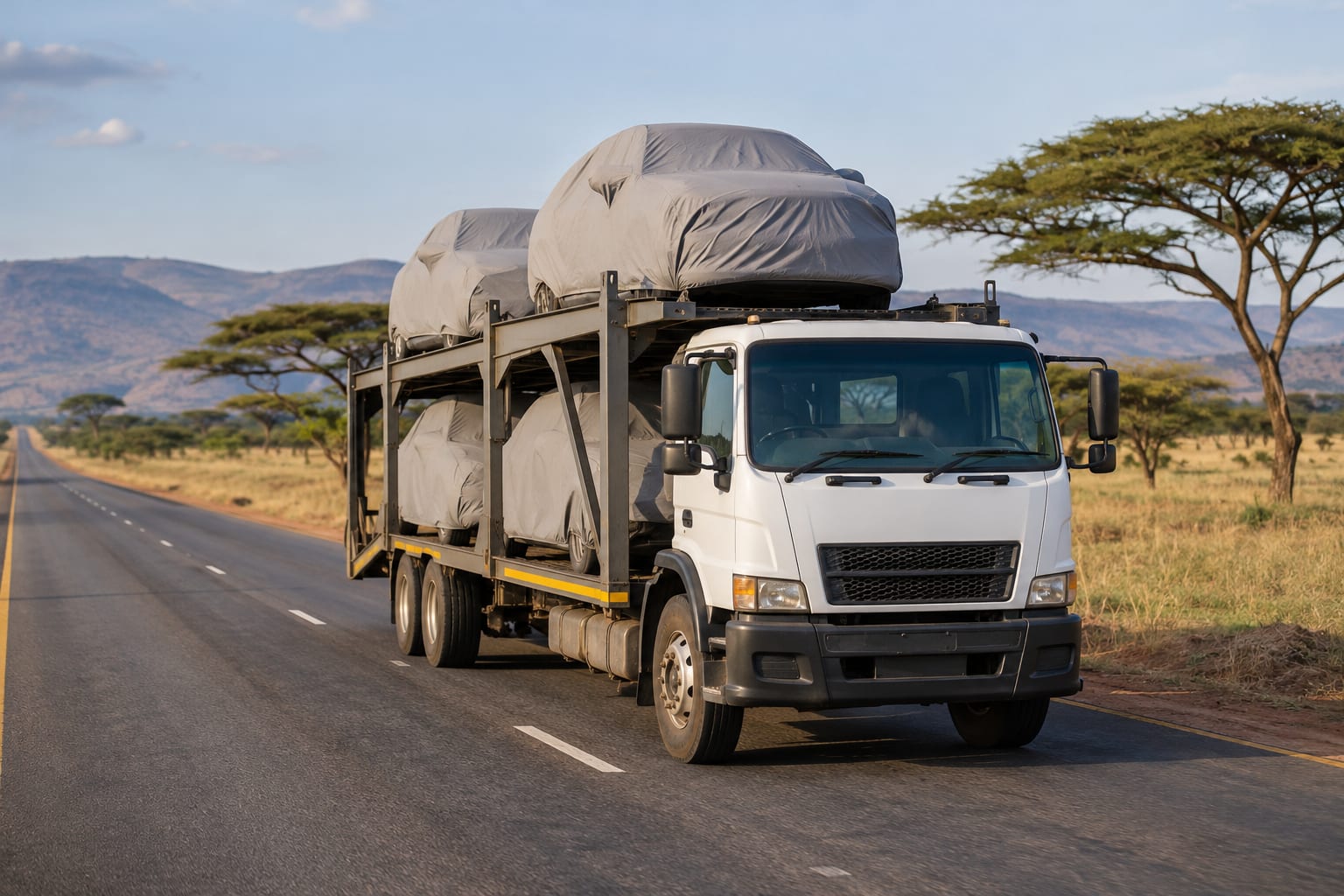 Illustration: A car transporter carries covered vehicles along a savanna highway.
The RTSA fees are the small, published part of the bill. Budget for the rest from current quotes.
What do you sort out after the car lands?
The order runs customs first, then the RTSA physical inspection and Interpol clearance, then RTSA registration, then road tax. ZamPortal lists customs, Interpol, registration and road tax in that order, and its Interpol list asks for the RTSA physical inspection as a supporting document, so the inspection comes before Interpol. Confirm the order with RTSA or a licensed clearing agent.
- The car arrives. It ships RoRo from Japan to Dar es Salaam, then travels overland into Zambia.
- ZRA customs clearance. Duty is assessed and paid. ZRA issues the receipt, release order and Customs Clearance Certificate.
- RTSA physical inspection. ZamPortal lists the inspection as a supporting document for the Interpol application, so it comes first.
- Interpol clearance. Zambia Police issue the clearance certificate.
- RTSA registration. You submit the documents and pay the listed fee.
- Road tax. ZamPortal lists this as a separate RTSA step with no supporting documents.
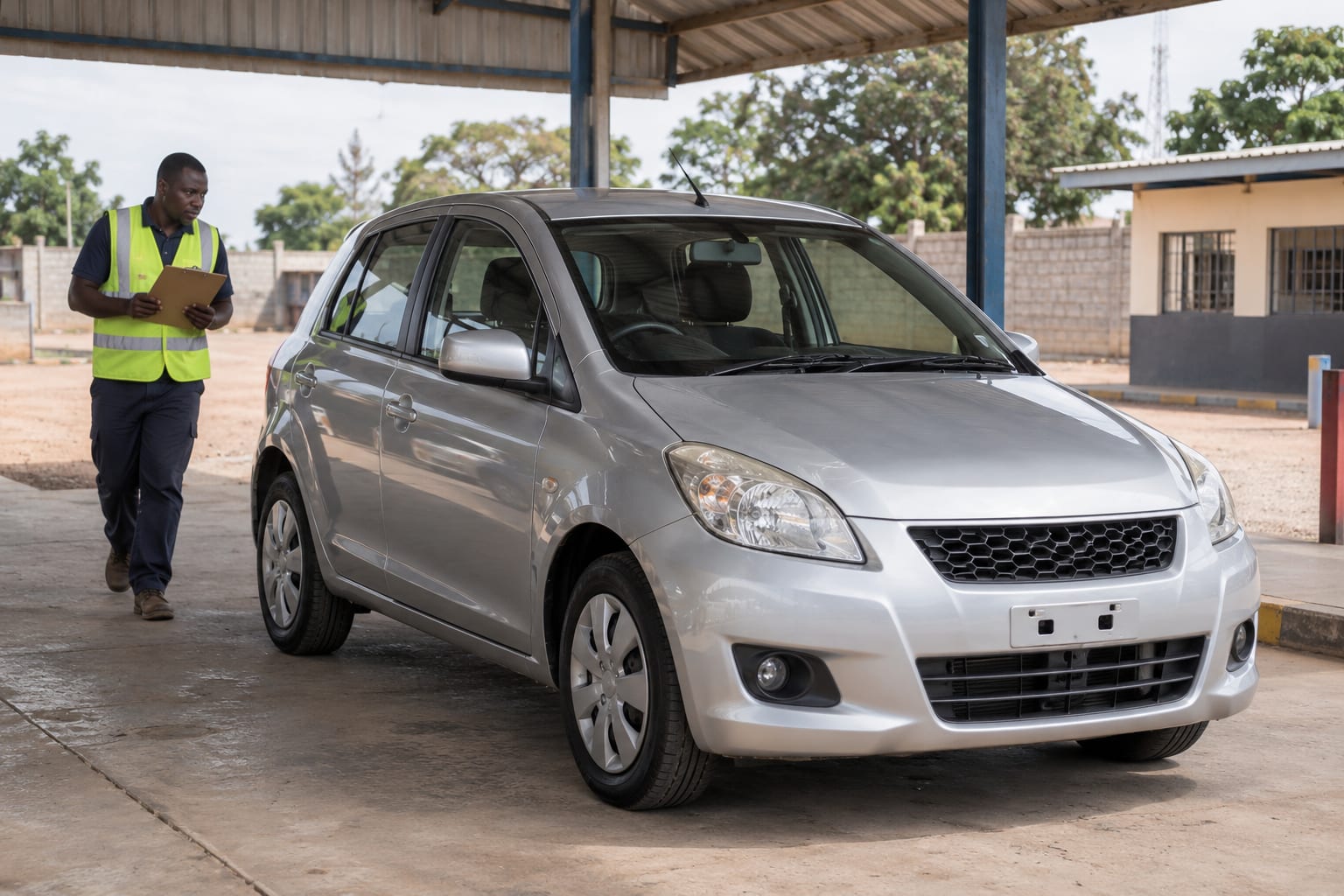 Illustration: An inspector with a clipboard walks beside a silver hatchback in a covered inspection bay.
One point to watch. ZamPortal also lists a Safety Inspection, or "Road Fitness Test", for used vehicles. It isn't clear whether that is the same thing as the K64 physical inspection or a separate check. Ask RTSA before you assume one fee covers both.
For the Japan side of the journey, Carbarn's step-by-step import guide covers choosing a car, shipping and what to expect at the port. If you're still weighing import against a Lusaka lot, the guide to finding used car deals in Zambia sets out the trade-offs.
Where does Carbarn fit?
Carbarn sells the car from Japan and gets it to the port. Every vehicle it lists is shown with its official Japanese auction sheet and an in-house inspection report before you pay, JEVIC-certified before export, and shipped RoRo to Dar es Salaam. The listed price covers the vehicle, shipping and the JEVIC inspection, but not duty, clearance or registration.
Everything in this article after the port is yours to handle. Carbarn's Terms and Conditions, section 2, state: "We do not engage in local sales, vehicle registration, or after-arrival services." Section 7 adds: "All customs clearance, import duties, and registration are the responsibility of the Purchaser."
To see how a purchase runs from choosing a car to tracking the vessel, read the how to buy guide. The import rules page covers eligibility and the export documents you'll carry to ZRA. The full terms and conditions spell out where Carbarn's role ends.