Importing a Car to Zambia from Japan: Duty, Port Routes and What It Really Costs to Land
Importing a Car to Zambia from Japan: Duty, Port Routes and What It Really Costs to Land
Read Our Blogs today and Learn More
Loading ...
Frequently Asked Questions (FAQs)
Carbarn's Zambia import rules guidance states that it accepts vehicles without a maximum age restriction. That is commercial guidance, not a substitute for confirmation with ZRA and the relevant registration authorities. Vehicle age still affects duty treatment, so check the current assessment before purchase. Also confirm that the vehicle meets Zambia's current steering-position and registration requirements. Older cars need careful checks for condition, parts availability, maintenance needs, fuel use and resale.
Not automatically. In 2026, Carbarn's How to Buy page describes its listed package as covering the vehicle, shipping and a pre-shipment inspection. Confirm which currently appointed inspection agent is handling the vehicle and what the individual quotation includes. Customs duties, port-clearance charges and local registration remain separate unless the quotation clearly says otherwise.
No. In 2026, the Tanzania Ports Authority's Dar es Salaam Port page identifies Zambia as one of seven landlocked countries served by the port. Dar es Salaam is a major route, while other maritime options may be available before overland transport into Zambia. Confirm the route, charges and responsibilities before payment.
For planning only, use an internal estimate of about 6 to 10 weeks from purchase confirmation to delivery in Zambia. Treat it as non-guaranteed, not a promise. Vessel schedules, port handling, document readiness, customs procedures, border movement and inland transport can all affect the final timing, so confirm the current estimate and what it covers before payment.
In 2026, the Zambia Revenue Authority's Valuation of Goods guidance describes six valuation methods and explains how CIF to the point of entry may form part of customs valuation, subject to adjustments. Some tariff classifications use specific duty instead, including treatment for certain used hybrids. ZRA determines the applicable assessment using current rules, schedules and vehicle details.
I am a Turkish-Australian automotive writer with a passion for hybrid vehicles and rugged 4WD adventures. My writing combines detailed technical insights with a love for outdoor exploration and Aussie driving culture. Having guest posted for leading automotive sites, my mission is to educate and inspire drivers considering greener and tougher vehicle options.
Published Date
August 26, 2026
Importing a car to Zambia from Japan can look affordable when you first see the Japanese auction price. That figure is only the starting point, though. Zambia is landlocked, so the car also needs sea freight, port handling and inland transport before it reaches its final destination.
The final budget can also include customs assessment, clearing-agent charges, registration, inspection and local delivery. This guide explains what each figure means, how the Dar es Salaam route works, and which costs you should confirm before ordering.
Quick Answer
The Japanese purchase price is only one part of the import budget.
ZRA applies current valuation and tariff rules to vehicle details; CIF does not describe every specific-duty assessment.
Dar es Salaam is a major route; other maritime options may be available.
Delivery is an internal, non-guaranteed estimate of about 6 to 10 weeks from purchase confirmation to delivery in Zambia.
Customs, port clearance and registration costs must be confirmed separately.
Understanding Landed Cost in Zambia
In 2026, Zambia Revenue Authority's Valuation of Goods guidance explains how CIF to the point of entry may form part of customs valuation, subject to additions and deductions. The tariff can also apply specific duty by classification, including treatment for some used hybrids. Landed cost is broader. It combines the vehicle, transport, customs, clearance and local steps needed before you can use the car.
The Japanese purchase price is what the vehicle costs in Japan. The exporter's quoted price may add shipping, inspection or export services. The CIF value means cost, insurance and freight to the relevant point of entry for customs valuation. These figures are related, but they are not interchangeable.
For planning purposes, landed cost means the expenses of bringing the vehicle into Zambia. Registered on-road cost is a further budgeting label for local inspection, registration, insurance and other setup costs. These are planning definitions, not formal customs terms. Always check the pro forma invoice to see exactly which items the quotation includes.
Car import paperwork and keys arranged on an office desk.
Term
What it means
Why it matters
Japanese purchase price
The vehicle price in Japan
Starting point only
CIF value
Customs valuation concept covering cost, insurance and freight
Used in the ZRA valuation process
Landed cost
The transport and import cost into Zambia
Helps you plan the import budget
Registered on-road cost
Landed cost plus local registration and setup
Closer to the amount needed for road use
Illustrative planning example
For a modest Japanese import, a useful starting budget might be a vehicle in the K150,000–K250,000 range, plus Japan-side shipping and inspection, port handling, inland transport, the current ZRA assessment, RTSA registration, insurance and a contingency. If those non-vehicle items add roughly K100,000–K250,000 before the ZRA assessment, the pre-customs planning total is about K250,000–K500,000. The final registered cost can be higher after ZRA assesses the vehicle.
This is an illustrative budgeting example, not a quotation or an official tariff calculation. It shows the method: vehicle price + included or separate shipping and inspection + port and clearance charges + inland transport + ZRA assessment + registration and insurance + contingency = estimated on-road budget. Confirm each figure against the pro forma invoice, current authority charges and the vehicle's accepted customs value before ordering.
The most useful budgeting habit is to keep these four figures separate. A low auction price can still produce a higher landed cost if the vehicle has a larger engine, a different classification, a longer inland journey or additional port charges.
Import Duty Calculation in Zambia
In 2026, the Zambia Revenue Authority's Valuation of Goods guidance identifies six sequential valuation methods, beginning with transaction value and followed by methods based on identical goods, similar goods, deductive value, computed value and a fallback method. ZRA therefore determines the assessment using current rules and vehicle details.
CIF-based valuation is important, but it does not describe every 2026 assessment. Some vehicles are assessed ad valorem, using a value-based calculation, while specific duty can apply according to the tariff classification. The current Customs and Excise changes also include specific treatment for used hybrid vehicles. Engine capacity, vehicle type, age, classification and the accepted customs value can all affect the result. The Japanese auction price may be relevant without being the only figure used. Check the Customs and Excise (Amendment) (No. 2) Act, 2025, which took effect on 1 January 2026, alongside the current ZRA tariff material.
Customs duty is also only one possible part of the government assessment. Other applicable taxes or vehicle-related charges may need checking, alongside clearance and administrative fees. Do not combine these categories into one old percentage copied from social media.
Use the current ZRA assessment as the figure that matters. An online calculator, an old importer article or a rate from another country might give a rough planning signal, but none should become your final budget.
In 2026, ZRA's six-method valuation framework shows why import duty cannot be calculated reliably from an auction price alone (Zambia Revenue Authority, “Valuation of Goods”, 2026). Engine capacity, classification, age and accepted customs value can all affect the result.
Which Port Route Is Used for Cars Going to Zambia?
In 2026, the Tanzania Ports Authority's Dar es Salaam Port page says the port serves Zambia and six other landlocked countries. For a Japan-to-Zambia import, one common journey is Japan to Dar es Salaam, followed by inland transport through Tanzania and into Zambia. Other maritime routes may be available, subject to the supplier's route and transport plan.
Vehicles commonly travel from Japan by RoRo, or roll-on/roll-off shipping. The car is driven onto the vessel, secured for the sea journey and unloaded at the nominated port. The journey does not end when the vessel arrives.
The Central Corridor connects its seven member governments to the sea through Dar es Salaam, according to the Central Corridor Transit Transport Facilitation Agency. That makes Dar a practical gateway for the inland leg towards Zambia, but it is not the only maritime option. Confirm any alternative route and its charges with the supplier and relevant authorities.
An alternative southern route may be possible. Route choice can affect port handling, inland transport, border procedures, clearance arrangements and delay exposure. No route should be promised as universally cheaper or faster.
Silver sedan at a commercial port with carrier truck and cargo containers.
Confirm the nominated port and the onward transport plan before payment. Ask who is responsible for port release, inland movement and local clearance. Those details can change the amount you need after the vehicle leaves Japan.
In 2026, Dar es Salaam Port reported that it serves seven landlocked countries, including Zambia (Tanzania Ports Authority, “Dar es Salaam Port”, 2026). For Zambian buyers, the sea journey is only the first stage, followed by inland transit and customs procedures.
What Happens After the Car Leaves Japan?
In 2026, the ZRA Trade Facilitation Tools page states that pre-registration is mandatory and involves lodging documents before importation. The practical journey therefore includes document preparation as well as physical transport, from export preparation through to customs release and registration.
The stages usually look like this:
Confirm that the vehicle meets Zambia's current import and registration requirements, including any steering-position requirement that applies.
Review the auction sheet and available condition information.
Confirm the vehicle details, destination and pro forma invoice.
Complete payment under the agreed supplier terms.
Complete export preparation and required pre-shipment inspection.
Book the vehicle on a suitable RoRo vessel.
Track the shipment and organise the document chain.
Arrange port handling, inland transport and clearance procedures.
Complete the ZRA customs assessment and payment process.
Present the vehicle for RTSA inspection and registration.
A vehicle arriving at Dar es Salaam is not the same as a vehicle cleared and registered in Zambia. Port arrival, customs release and road registration are separate milestones.
A useful tracking structure is Ready to Ship, Shipped and Arrived. These stages help you understand where the vehicle is, but they do not remove the need to arrange local clearance, registration and payment of government charges.
Which Import Costs Are Included and Which Are Separate?
In 2026, the Zambia Revenue Authority's Importation of Goods guidance separates customs declarations, supporting documents, assessment and payment. That distinction matters because a supplier quotation, a customs assessment and a registered on-road budget describe different parts of the same import journey.
Use the table below as a planning checklist. Each supplier handles its package differently, so confirm every item in writing.
Cost category
Planning treatment
Vehicle purchase price
Check whether it is included in the quoted package
Japan-side shipping
Confirm whether included
Marine insurance
Confirm whether included or separate
Auction sheet
Confirm whether supplied before payment
Inspection report
Confirm whether supplied before payment
ZCSA pre-shipment roadworthiness inspection
Confirm the currently appointed inspection agent and whether the inspection is included
ZRA customs assessment
Separate government assessment
Customs duties and applicable taxes
Confirm separately
Port handling
Confirm with the supplier or appointed agent
Port clearance
Confirm who is responsible
Clearing-agent fees
Confirm in writing
Inland transport
Depends on route and final destination
RTSA inspection and registration
Separate local process
Insurance after import
Separate buyer decision
Repairs and servicing
Separate ownership costs
Storage or delay charges
Contingency item, depending on delay and provider
A price that covers the vehicle and shipping is not automatically a fully landed, registered or on-road price. This is where many first-time importers under-budget.
The cheapest route on paper may not be cheapest in practice. A delay can create extra handling or storage charges, while an unclear responsibility split can leave you paying for services you thought were included.
What Documents, Timeline and Budget Checks Should You Confirm?
In 2026, the Road Transport and Safety Agency's vehicle-registration guidance names customs clearance, a ZRA receipt, a CE20 customs declaration, a release order, Interpol clearance, physical inspection, owner identification and insurance among the registration requirements. Prepare this chain before the vehicle arrives.
Keep the process documents separate by stage. ZRA customs clearance may involve the commercial or original invoice, pro forma invoice, Japanese export certificate, bill of lading, customs declaration and release documents. Interpol clearance and the RTSA physical inspection and registration can require their own supporting documents, such as inspection receipts, tax-clearance evidence, owner identification and insurance. A current ZCSA roadworthiness-inspection certificate from an appointed agent may form part of the chain. Confirm the exact checklist with ZRA, Interpol and RTSA rather than assuming every document is submitted at first registration.
RTSA's physical-inspection guidance also refers to the vehicle, inspection receipt, ZRA tax clearance, release order, receipt and owner identification. The exact checklist can depend on the import and registration circumstances, so confirm it with the relevant authority.
For planning only, use an internal estimate of about 6 to 10 weeks from purchase confirmation to delivery in Zambia, not a published service commitment. Treat it as non-guaranteed, because vessel schedules, port handling, document readiness, customs assessment, border procedures and inland transport can all affect timing. Confirm the current estimate and what it covers before payment.
Your estimated budget should include:
The vehicle price and any included shipping.
The current ZRA assessment.
Port handling, clearance and clearing-agent charges.
Inland transport to the final destination.
RTSA inspection, registration and insurance.
A contingency for additional handling or delays.
Estimated on-road budget = vehicle and included shipping costs + ZRA assessment + port and clearance costs + inland transport + registration, insurance, storage contingencies and other local setup costs.
This is a planning formula, not an official Zambian calculation. The ZRA assessment can include applicable customs duty, VAT, excise or surtax according to the current tariff treatment.
Importer reviews vehicle paperwork with a car and container behind him.
How Does Carbarn Support the Japan-to-Zambia Process?
In 2026, Carbarn's How to Buy page says buyers receive two reports before payment: the official Japanese auction sheet and an in-house inspection report. The same page describes a listed price covering the vehicle, shipping and a pre-shipment inspection, while customs, port clearance and registration remain separate. Confirm which currently appointed inspection agent is handling the vehicle.
Carbarn describes itself as a Japan-based vehicle exporter selling vehicles through Carbarn Zambia’s vehicle platform. Used vehicles destined for Zambia must complete the mandatory ZCSA pre-shipment roadworthiness inspection through a currently appointed inspection agent; confirm whether JEVIC or another approved agent is handling the vehicle. Vehicles may travel by RoRo to Dar es Salaam, with Durban and Walvis Bay among the alternative maritime routes.
The dashboard provides access to invoices, inspection sheets, certificates, the bill of lading and vessel-tracking updates. Its status stages are Ready to Ship, Shipped and Arrived. Confirm the payment terms and due date on the official invoice before proceeding.
The practical takeaway is simple: do not budget from the Japanese vehicle price alone. Separate the purchase price, CIF value, ZRA assessment, landed cost and registered on-road cost before you commit.
Check the vehicle's engine capacity, age, body classification and documents. Then confirm the current ZRA position, the nominated port, inland transport arrangements and every charge shown on the quotation.



 Car import paperwork and keys arranged on an office desk.
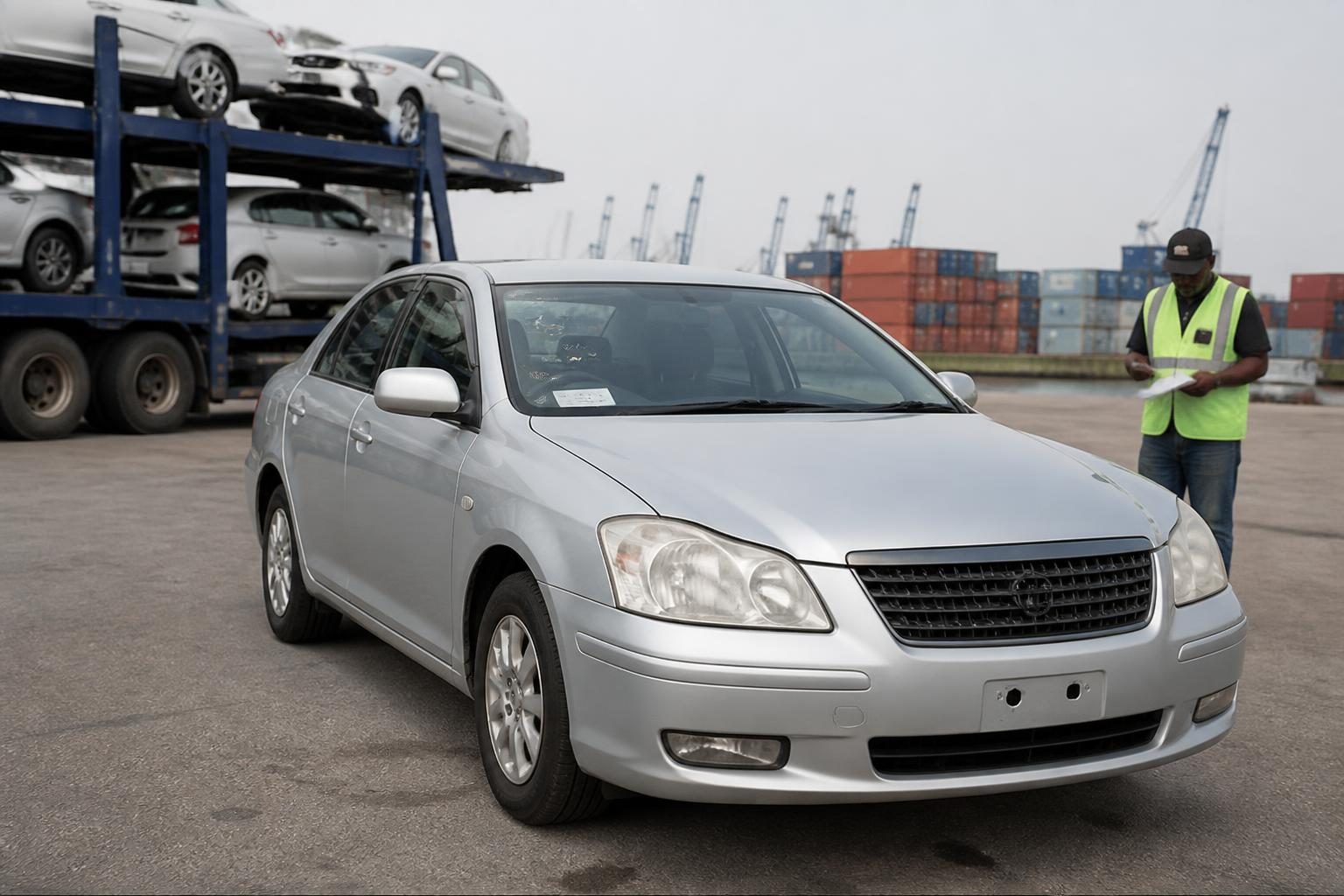 Silver sedan at a commercial port with carrier truck and cargo containers.
 Importer reviews vehicle paperwork with a car and container behind him.