Fuel is the single biggest running cost most Zambian drivers face, so the two cars that promise to cut that bill hardest get looked at constantly. One is the Toyota Prius, a petrol-electric hybrid. The other is the Nissan Leaf, a fully electric hatchback that often appears at a noticeably lower price. On a listing page they look like two answers to the same question. In Zambia, they are not.
This guide compares them the way a buyer in Lusaka, Kitwe or Livingstone actually has to: what each one costs to buy, what it costs to run here, what breaks, what it is worth in three years, and whether the car can physically complete the trips you need it to make. The verdict is not close for most people, and the reason has less to do with the cars than with where you plug them in.
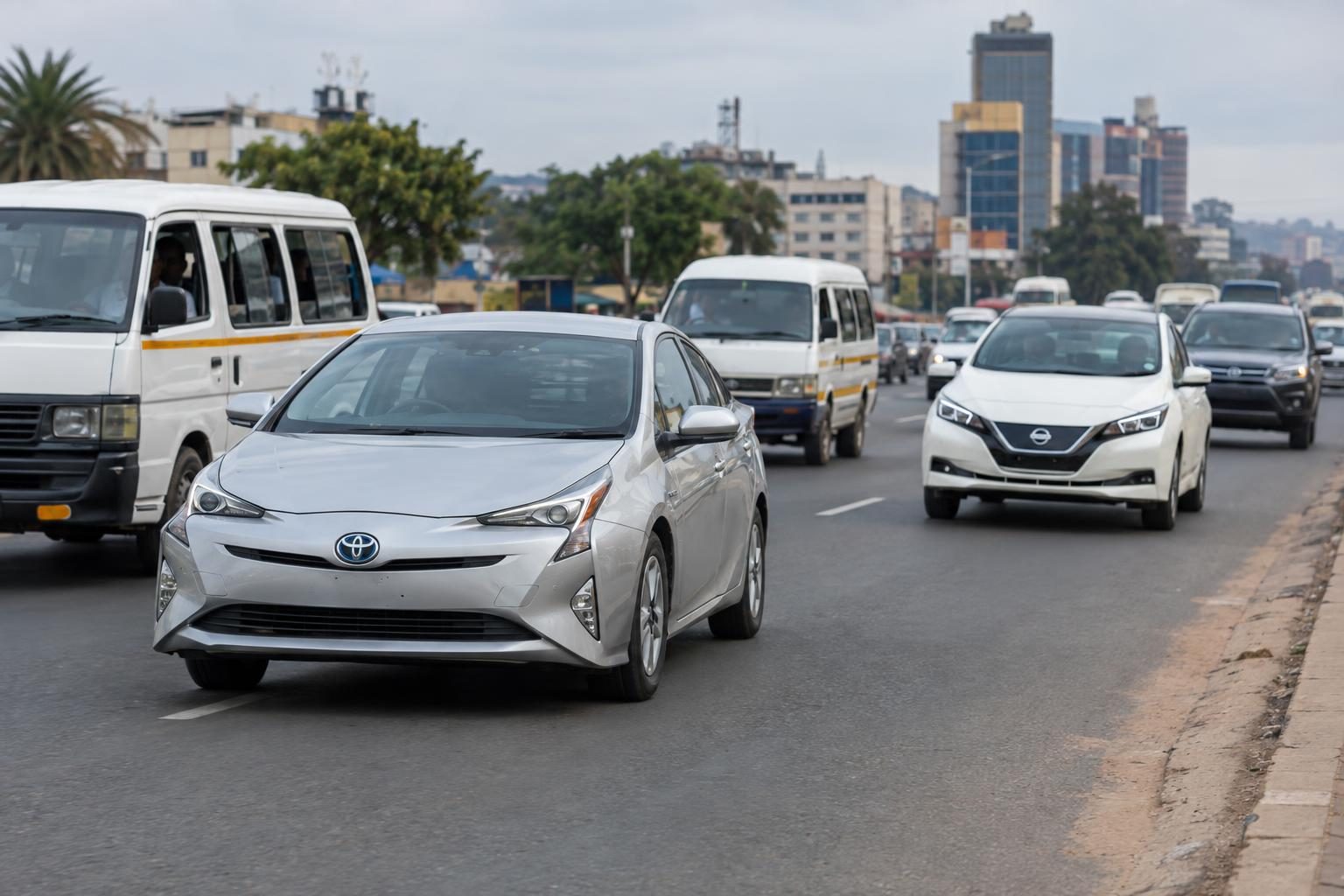 A Toyota Prius, Nissan Leaf and minibuses in busy urban traffic.
Quick Answer
- Most Zambian buyers should take the Prius. It needs no charging infrastructure, covers 700 km or more on a tank, and holds value far better.
- The Leaf only works as a city car with reliable home charging, ideally solar-backed. Public charging in Zambia exists in Lusaka, Kitwe and Ndola only, at malls and offices (EV24.africa, March 2026).
- Running costs favour the Leaf heavily. EV24.africa puts a Lusaka to Kitwe run at roughly K200 in electricity against K1,500 to K2,000 in petrol.
- Resale punishes the Leaf. The Prius retains 67.1% of value at five years (iSeeCars, 2026); the Leaf retains 34.2% (CarEdge, 2026).
- Heat is the Leaf's weak point. No Leaf generation uses liquid battery cooling, and hot-climate Gen 1 cars have lost 25% to 40% capacity by five to seven years (Recurrent Auto).
What Are You Actually Choosing Between?
These are two different machines, not two trim levels of the same idea. A hybrid Prius makes and stores its own electricity while you drive. A Leaf stores electricity you supply from a wall. That single difference decides almost everything else about ownership in Zambia, where only 269 electric vehicles were registered nationally as of July 2025, up from 62 two years earlier, against a total fleet of 823,703 vehicles (CleanTechnica, August 2025).
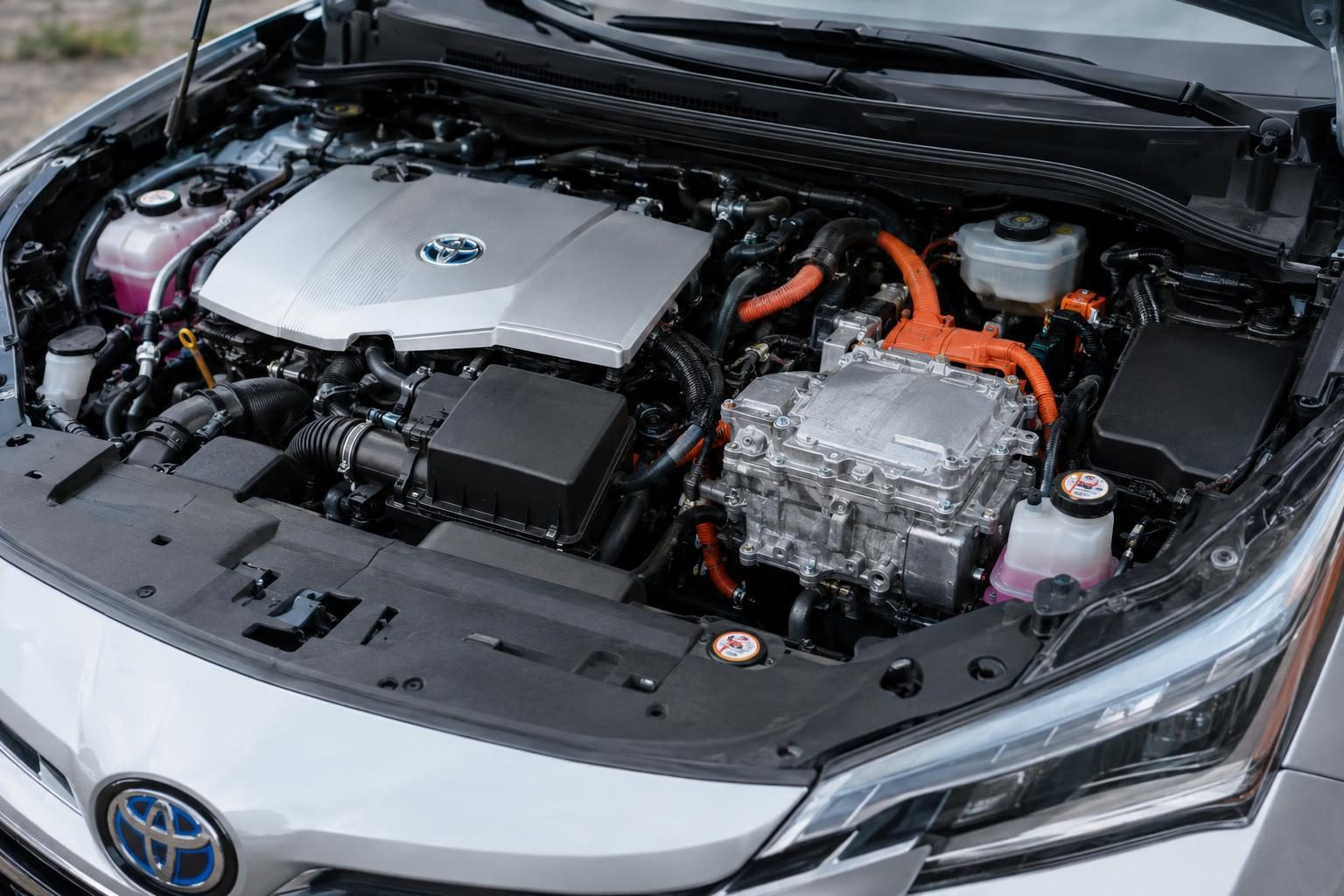 Toyota Prius hybrid engine bay with orange high-voltage cables and electric-drive hardware.
The Prius carries a 1,800 cc petrol engine, an electric motor and a small battery. The engine charges the battery, the motor assists the engine, and the car shuts the engine off in traffic. You fill it at any fuel station in the country. Nothing about the car asks anything of ZESCO.
The Leaf has no engine at all. It has a motor, a large lithium battery and a charge port. Every kilometre you drive has to come out of a socket first. When that socket is dependable, the Leaf is extraordinarily cheap to run. When it is not, the car simply does not move.
That is the whole comparison in two paragraphs. The rest of this article is about how big the gap gets once Zambian roads, Zambian heat and Zambian electricity supply are factored in.
Prius vs Leaf at a Glance: How Do They Compare?
On paper the Leaf wins on purchase price and running cost, and the Prius wins on everything to do with range, flexibility and resale. The table below uses verified Japanese-market manufacturer figures, with the test cycle labelled in every case, because JC08 and WLTC numbers are not interchangeable and mixing them makes a car look better than it is.
|
Toyota Prius (ZVW50/51, Gen 4) |
Nissan Leaf (ZE1, 40 kWh) |
| Powertrain |
1,800 cc 2ZR-FXE petrol-electric hybrid |
Single electric motor, 40 kWh battery |
| Energy source |
Any fuel station |
Wall socket or public charger |
| Official economy or range |
37.2 km/L JC08 standard 2WD, 40.8 km/L JC08 E-grade (Toyota Global, December 2015) |
322 km WLTC, about 400 km JC08 (Nissan Japan, ZE1 40 kWh specification; cross-referenced Nissan Leaf — Wikipedia) |
| Realistic Zambian range per fill or charge |
Comfortably 700 km or more |
Roughly 220 to 260 km in hot conditions |
| Battery cooling |
Engine-managed hybrid pack |
Passive air cooling only, no liquid system (Nissan Leaf technical record) |
| Lusaka to Livingstone in one go |
Yes |
No |
| 5-year value retention |
67.1% (iSeeCars, 2026) |
34.2% (CarEdge, 2026) |
| Parts and servicing in Zambia |
Widely understood |
Specialist only |
| Typical price band in ZMW |
Around the K250,000 to K300,000 mark for a recent low-odometer car |
Under K150,000 for an older higher-odometer car |
Those price bands move with the auctions and the exchange rate, so treat them as shape rather than quotation, and check the live listing for a current figure. They cover the vehicle, shipping and JEVIC inspection. They do not include Zambian customs duties, port clearance or registration, which are the buyer's responsibility. The mechanics of how duty is assessed, including the role of engine capacity and vehicle age, are set out on the import rules and regulations page.
Toyota Prius ZVW51: The Default Choice for Zambian Roads
The Toyota Prius earns its place here by being boring in the best way. It does roughly 1,200 km between fills on an urban commute, needs no infrastructure that does not already exist, and its hybrid system has been in continuous production since 1997. The specific car worth looking at as a benchmark is a 2019 Prius S Touring Selection, model code ZVW51, with 68,000 km on the odometer and an auction grade of 4.5.
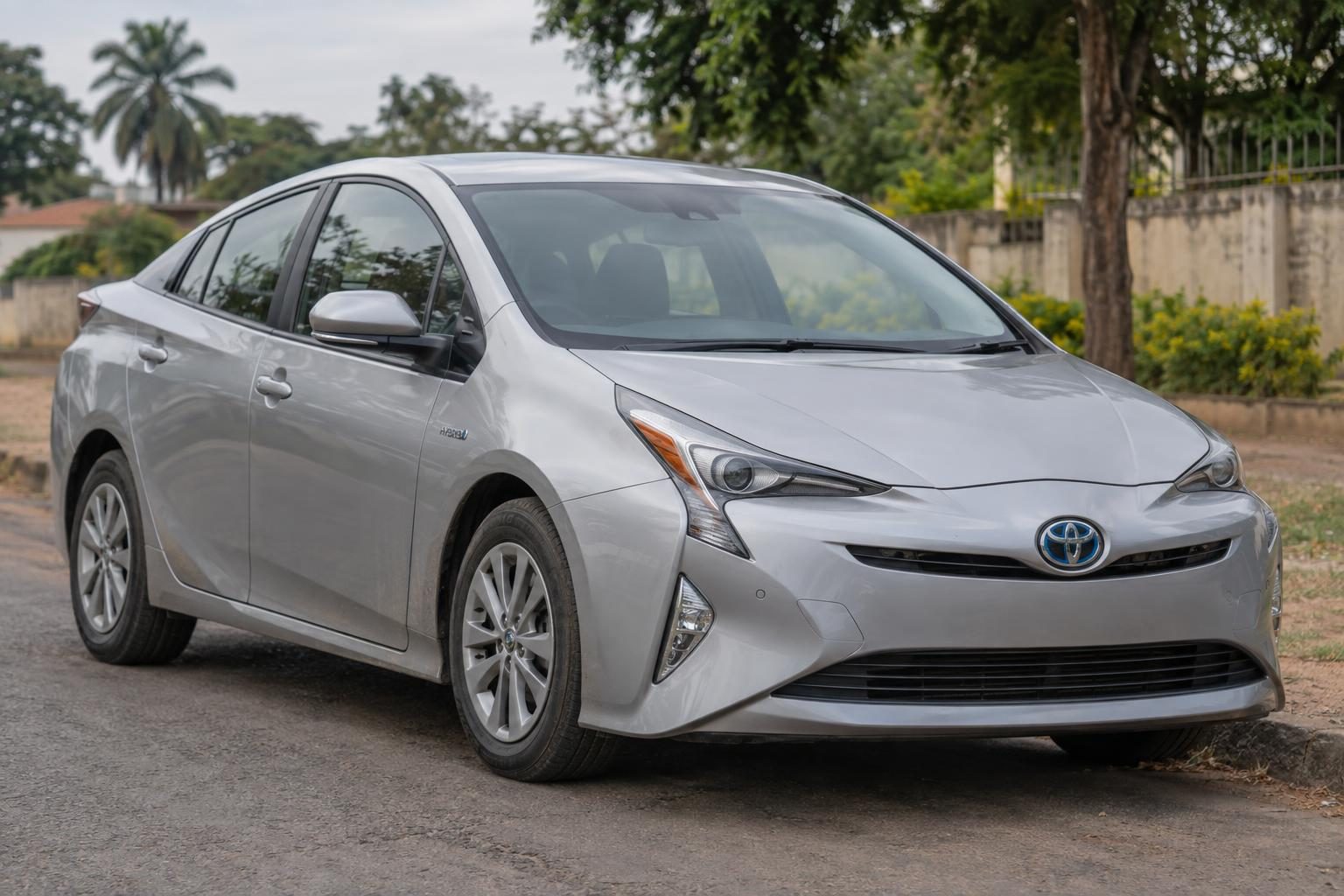 2019 Toyota Prius
An auction grade is the score a Japanese auction inspector gives a car on arrival at the auction house, before anyone buys it. Grade 4.5 sits near the top of the practical scale and signals a straight, well-kept car. On this particular unit the in-house inspection records a clean underbody, no windscreen damage, no cigarette burns, a normal interior smell and 4 mm of tread front and rear. Tread at 4 mm is serviceable but worth budgeting to replace within the first year of Zambian driving.
The powertrain is the 1,800 cc 2ZR-FXE, a water-cooled inline-four with DOHC, driving the front wheels through a CVT automatic. The listing records 98 kW of power. Toyota's own fourth-generation specification breaks that down as a 72 kW, 142 Nm petrol engine working with a 53 kW, 163 Nm electric motor, which is why the car feels unexpectedly brisk off the line even though its on-paper output is modest. Physically it measures 4,575 mm long, 1,760 mm wide and 1,470 mm tall on a 2,700 mm wheelbase, with five seats and a sedan body. Safety equipment includes driver, passenger and side airbags, ABS, traction control, electronic brake-force distribution and brake assist. Comfort items run to air conditioning, power windows, steering adjustment, UV filter glass and folding rear seats.
Fuel economy is the reason people buy it, so the figures deserve care. Toyota rated the standard 2WD fourth-generation Prius at 37.2 km/L on the JC08 cycle, with the lightweight E-grade reaching 40.8 km/L JC08 (Toyota Global, December 2015). Real Zambian driving with air conditioning running and rough surfaces will land below either figure. Even at a conservative discount, you are looking at a car that halves the fuel bill of a comparable petrol saloon, and the low 1,470 mm roofline keeps it quiet and stable on a long inter-town run. The honest weakness is ground clearance. This is a low car, and badly broken feeder roads or deep unsealed tracks will punish it. Full dimension and variant data by model code sits on the Toyota specifications pages.
Nissan Leaf ZE1: Cheap to Run, Narrow in Use
The Nissan Leaf is the most tempting and the most misunderstood car in this comparison. It is genuinely cheap to buy and genuinely cheap to run, and for a specific Lusaka buyer it is the smarter purchase. The reference car here is a 2020 Nissan Leaf, model code ZE1, pearl, auction grade 4, with 104,000 km recorded.
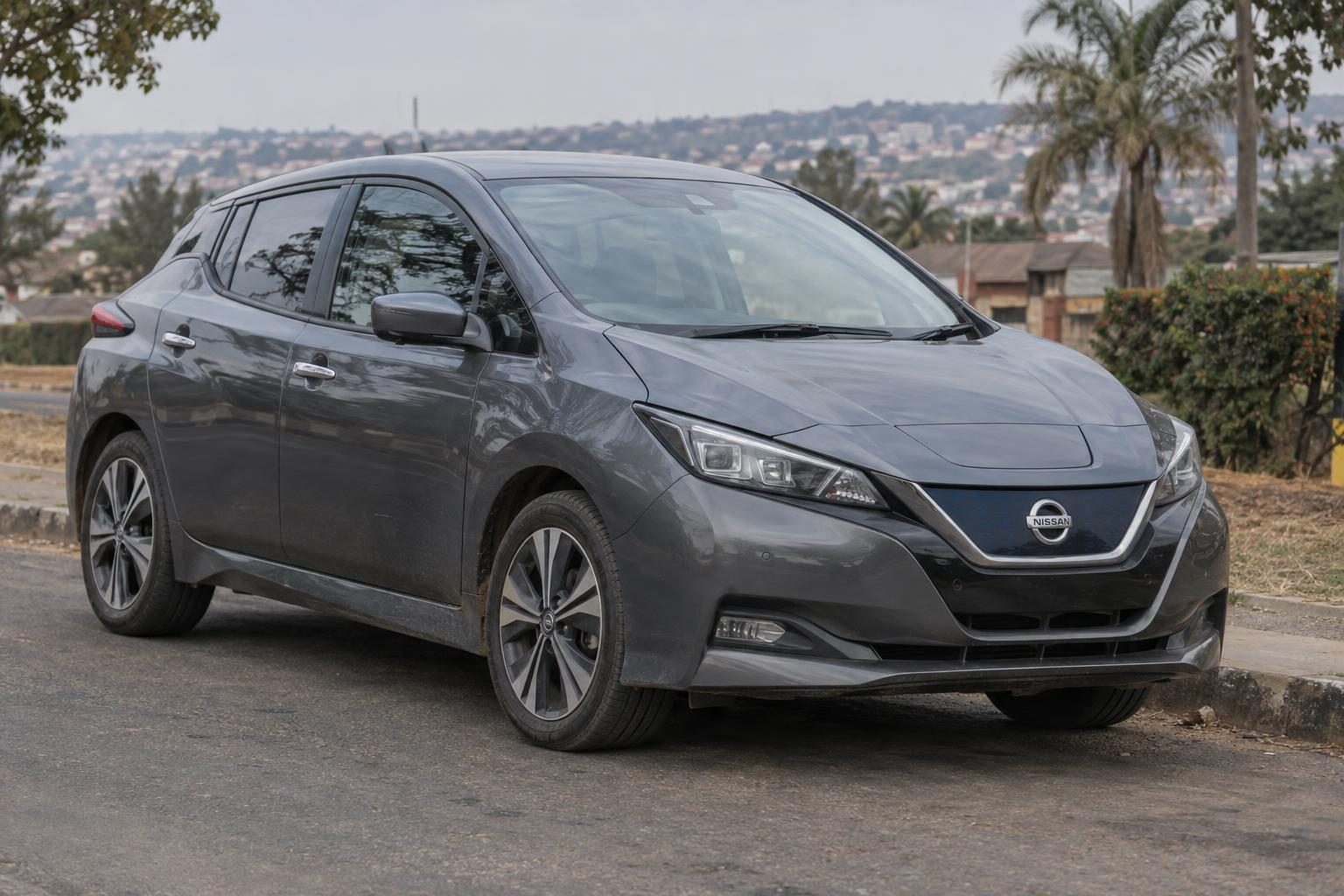 2020 Nissan Leaf
Read that odometer carefully. At 104,000 km over roughly six years, this car has worked about 17,000 km a year, which is above average use for an EV. The ZE1 generation, built from 2018, has no active thermal management on its battery pack. Cooling is passive air only, confirmed in the Leaf's published technical record. In Zambia's climate, expect measurable capacity loss over time. At this mileage a professional battery health audit before import is essential, not optional. A capacity reading taken through an OBD2 tool or LeafSpy tells you what the car is actually worth. The odometer alone does not.
The specifications themselves are straightforward. The listing shows a hatchback body, five seats, automatic transmission and front-wheel drive, measuring 4,480 mm long, 1,790 mm wide and 1,560 mm tall on a 2,700 mm wheelbase. Engine size reads 0 cc, which is correct: there is no engine. Battery capacity does not appear on the listing, so it has to come from manufacturer data. The standard ZE1 Leaf of this year carries a 40 kWh pack rated at 322 km on the WLTC cycle and roughly 400 km under the older JC08 cycle, with a 110 kW, 320 Nm motor (Nissan Japan, ZE1 40 kWh specification). That torque figure explains the Leaf's best party trick. It pulls away from a Lusaka junction faster than almost anything near its price. The in-house inspection on this unit records a clean underbody, no dashboard or windscreen damage, 5 mm of front tread and 6 mm at the rear, which is healthier rubber than the Prius benchmark. Safety kit covers airbags, ABS, traction control, EBD and brake assist, with air conditioning, power windows, a rear wiper and tinted glass inside.
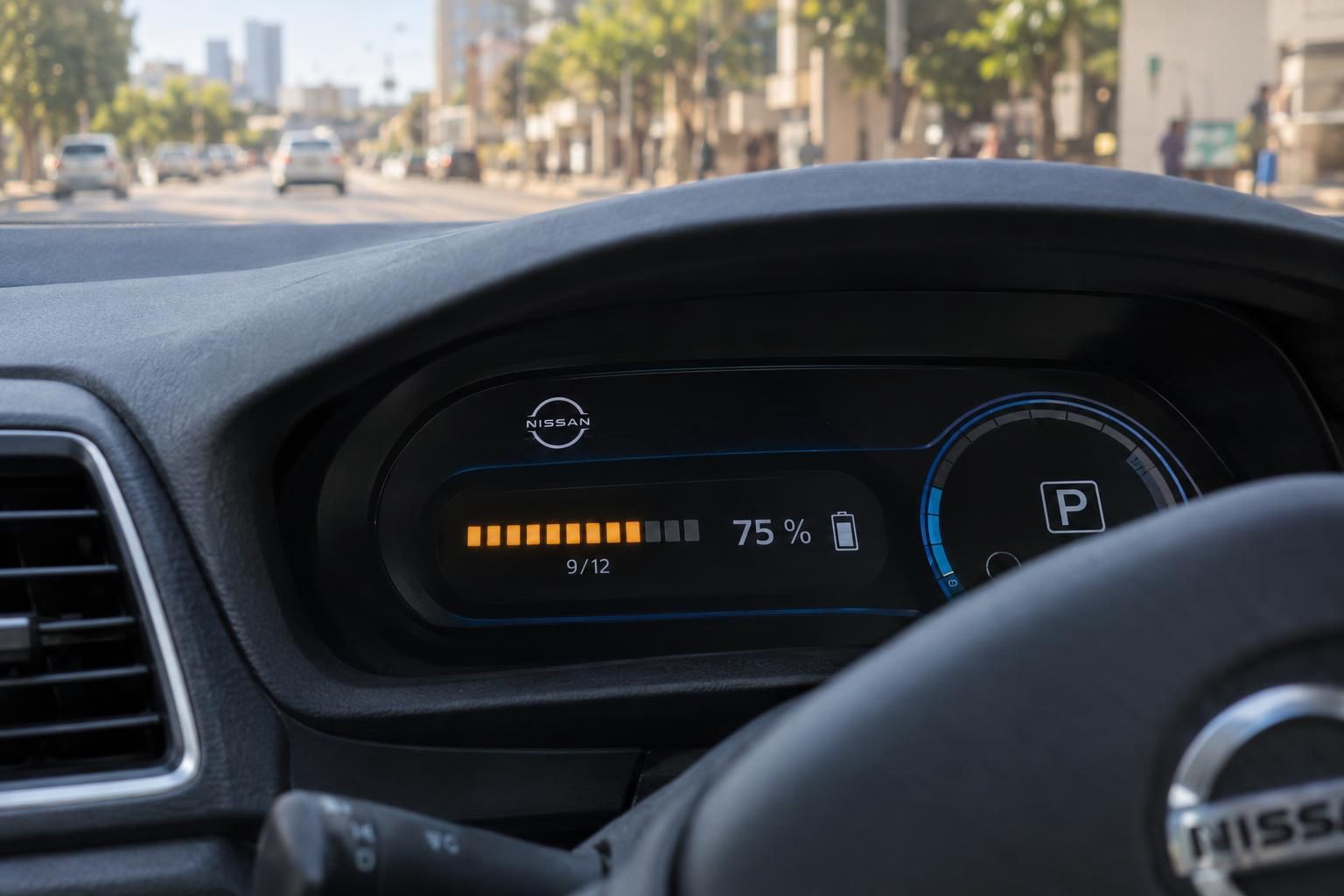 Leaf dashboard with 9 of 12 battery capacity bars illuminated.
Now the practical maths. That 322 km WLTC rating is a controlled-laboratory figure. Add Zambian heat above 35°C, air conditioning on full, and a pack that has already covered 104,000 km, and a realistic working range of roughly 220 to 260 km is the sensible planning assumption. Around Lusaka that is still three or four days of commuting between charges. On the Great North Road it is a problem, and the next section explains why.
Can Zambia's Charging Network Support a Leaf?
Not outside three cities, and not between any of them. Public charging in Zambia exists at malls and office buildings in Lusaka, Kitwe and Ndola, with nothing installed along the highways that connect them (EV24.africa, March 2026). Zambia is not unusual in this. Only 17% of African countries have ten or more public charging stations (EV24.africa, April 2025).
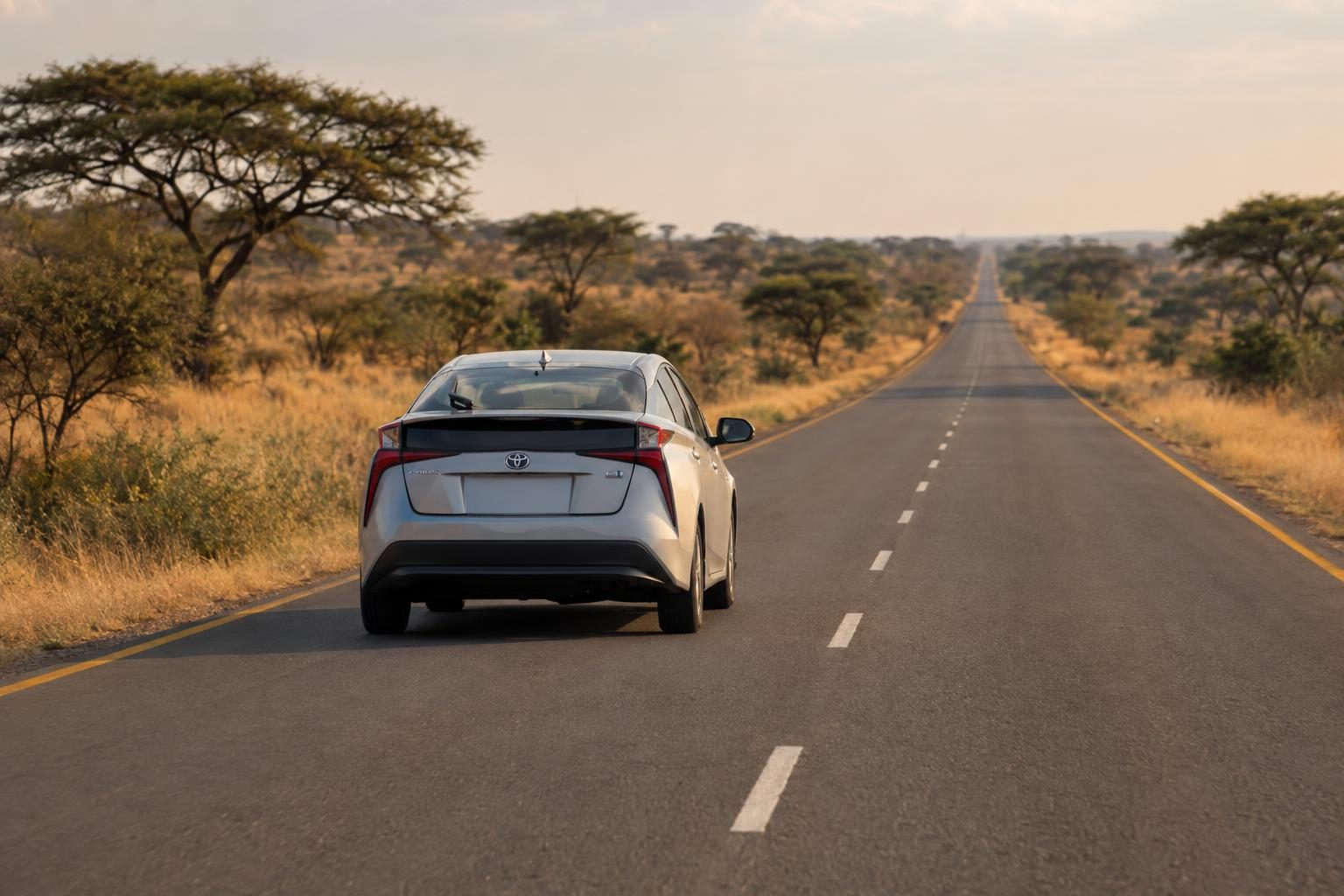 A silver Toyota Prius on a long dry savanna highway.
Apply that to real journeys. Lusaka to Kitwe is 357 km with no charging in between, a distance EV24.africa itself flags as the practical limit case. Lusaka to Livingstone is further again, roughly 470 km by road according to standard route-distance data for the T1. A degraded 40 kWh Leaf cannot make either trip without finding a 230-volt socket and a long wait at the halfway point. The Prius refuels in four minutes at any station on the route.
Then there is supply. About 90% of Zambia's electricity comes from hydropower, which makes the grid seasonally vulnerable (EV24.africa, March 2026). In the worst of the 2025 shortfall, severe ZESCO load-shedding left parts of the country with around seven hours of power a day, and some suburbs going without for up to 20 hours (MJ Consultants, 2025). An EV that charges overnight stops being a car when the overnight power is not there.
This is the strongest practical argument in the Prius's favour, and it has nothing to do with engineering quality. A hybrid is indifferent to all of it. The Leaf becomes viable the moment you can charge reliably at home, which in most Zambian cases means a solar installation with battery backup rather than a grid-only connection. Government and private work is moving in that direction, including a reported $20 million solar charging initiative through EVC Investments and the Ministry of Green Economy, but that is a future to plan around rather than a network to rely on today.
When the charging does work, the saving is real and large. EV24.africa costs a Lusaka to Kitwe trip at about K200 in electricity against K1,500 to K2,000 in petrol. If your driving fits inside the Leaf's envelope, nothing else at the price comes close on running cost.
What Does Zambia's Heat Do to a Leaf Battery?
Heat is the Leaf's structural weakness, because no generation of the car uses liquid battery cooling. Across all climates the average Leaf still retains 91% of its range at five years, measured across more than a billion real-world miles by Recurrent Auto. Hot climates break that average badly, and Zambia sits firmly on the wrong side of it.
| Leaf generation and climate |
Typical capacity loss at 5 to 7 years |
| ZE0 Gen 1 (2011 to 2017), hot climate |
25% to 40% |
| ZE0 Gen 1, mild climate |
10% to 15% |
| ZE1 Gen 2 (2018 to 2022), hot climate |
10% to 20% |
| ZE1 Gen 2, mild climate |
5% to 10% |
Those ranges are estimates based on real-world battery health data tracked by Recurrent Auto, which documents identical model years behaving very differently in hot versus mild climates. Individual results vary with usage patterns and charge habits. The practical reading for a Zambian buyer is blunt. Avoid ZE0 Gen 1 cars unless you have a verified capacity figure and a price that reflects a worn pack. A Gen 1 Leaf that has lost a third of its capacity is a 130 km city runabout, which may still suit someone, but it should not be bought at a healthy-battery price.
The ZE1 Gen 2 is meaningfully better thanks to revised cell chemistry, and that is why the 2020 car above is the right generation to consider. It is still air-cooled, though, so the same discipline applies. Ask for the dashboard capacity bar count, ask for an OBD2 or LeafSpy state-of-health reading, and treat the auction sheet grade as a verdict on the body rather than the battery. A grade 4 car can have an excellent shell and a tired pack. Battery replacement is the other half of this risk, since there is no established EV battery supply or specialist repair network in Zambia, so a failed pack becomes an import project of its own.
Which One Holds Its Value Better?
The Prius, by a wide margin, and this is where the Leaf's cheap purchase price gets repaid. The Toyota Prius retains 67.1% of its value after five years according to iSeeCars, whose 2026 analysis draws on more than 15 million vehicles. The Nissan Leaf retains 34.2% over the same period (CarEdge, 2026). An average car sits somewhere between the two.
| Model |
Value retained at 5 years |
What that means for you |
| Toyota Prius |
67.1% |
Resells easily, broad buyer pool |
| Average car |
roughly 45% to 50% |
Normal market behaviour |
| Nissan Leaf |
34.2% |
Narrow buyer pool, battery age discounts it further |
Those are global figures, and the Zambian picture is likely harsher for the Leaf rather than kinder. Resale depends on how many people want your car, and a used EV in Zambia competes for a buyer pool of a few hundred registered electric vehicles nationwide. A Prius competes in the largest and most liquid segment of the Zambian market, which is why hybrid Toyotas move so quickly here. Reliability perception reinforces it. Consumer Reports consistently rates the Prius higher than the Leaf for predicted reliability, and that reputation follows the car into the resale conversation.
What About Servicing and Parts in Zambia?
The Prius is serviceable almost anywhere; the Leaf is not. Carbarn's own market intelligence scoring for Zambia rates the Prius 3 out of 5 for parts and service and the Leaf 1 out of 5, describing Leaf parts support as limited. That gap matters more than any spec sheet line, because a car you cannot repair locally is a car that sits.
Prius servicing is routine work for Zambian workshops. Oil, filters, brakes, suspension and tyres are ordinary jobs, and the hybrid system itself needs little beyond keeping the battery cooling intake clean. The one expensive item is the traction battery, which eventually degrades, but reconditioned and replacement Prius packs circulate widely in the region because so many of these cars exist.
Leaf servicing has fewer moving parts and should in theory be cheaper. It mostly is: no oil changes, no exhaust, minimal brake wear thanks to regeneration. The problem is what happens when something electrical does fail. High-voltage work needs trained technicians and specific diagnostic tools, and that capability is not widely available in Zambia yet. Both cars are right-hand drive and both arrive with a JEVIC roadworthiness certificate completed before export, so neither has a compliance disadvantage. The difference is purely who can fix it on a Tuesday afternoon in Lusaka.
Which One Makes Sense for You?
Choose the Prius if any of the following is true, which for most Zambian buyers means choose the Prius. You drive between towns, even occasionally. You rent rather than own, or cannot install a charger. Your power supply is grid-only and subject to load-shedding. You want the car to resell easily in three years. You want a car any competent local workshop can service.
Choose the Leaf only if all of the following are true. Your driving is Lusaka, Kitwe or Ndola city running, under about 150 km a day. You own your home and can install a charger, ideally solar-backed with battery storage. You keep or can borrow a second vehicle for long trips. You have had the battery's state of health professionally verified before paying. You accept that resale will be slow and the price soft.
For a third group, neither answer is clean. If your budget is tight and your roads are rough, a smaller hybrid hatchback such as the Toyota Aqua covers similar fuel economy with a shorter, lighter body that copes better with broken surfaces. Comparing those options side by side with the Prius is worth doing before committing.
One advantage applies to both. Zambia sets no import age limit on used vehicles, so older Gen 3 Prius ZVW30 cars and early Leafs are legally importable where buyers in Uganda or Zimbabwe would be blocked. For the Prius that is genuinely useful, since a well-kept ZVW30 rated at 32.6 km/L JC08 (Toyota Global, May 2009) remains a sensible cheap car. For the Leaf, age is exactly the thing you are trying to avoid, so the freedom is less of a gift than it looks.
Importing a Prius or Leaf to Zambia
Both cars are imported to order from Japan, not bought off a yard, and that shapes how you should check them. Carbarn owns every vehicle it lists, so there are no broker cancellations, and each listing carries two reports before you pay: the official Japanese auction sheet with its grade, and an in-house Carbarn inspector report covering tyre tread, underbody, interior condition and damage. Every car is JEVIC certified before leaving Japan, ships RoRo to Dar es Salaam, with Durban as the alternative route, then travels overland into Zambia, taking about 6 to 10 weeks from purchase confirmation to delivery. Listed prices cover the vehicle, shipping and JEVIC inspection, while customs duties, port clearance and registration remain yours to pay, and each vehicle page shows an estimated landed cost to help you plan. Payment is full upfront by bank transfer to the official business account or by card, arranged on a proforma invoice, with no financing available at present. Imported cars carry no manufacturer warranty, though reliable local service providers can be recommended. Sales and support run through Carbarn Japan, and a self-service dashboard holds your invoice, inspection sheets, bill of lading, certificates and vessel tracking. Start with the Prius and Leaf pages, read the buying guide, and check the import rules before you commit.
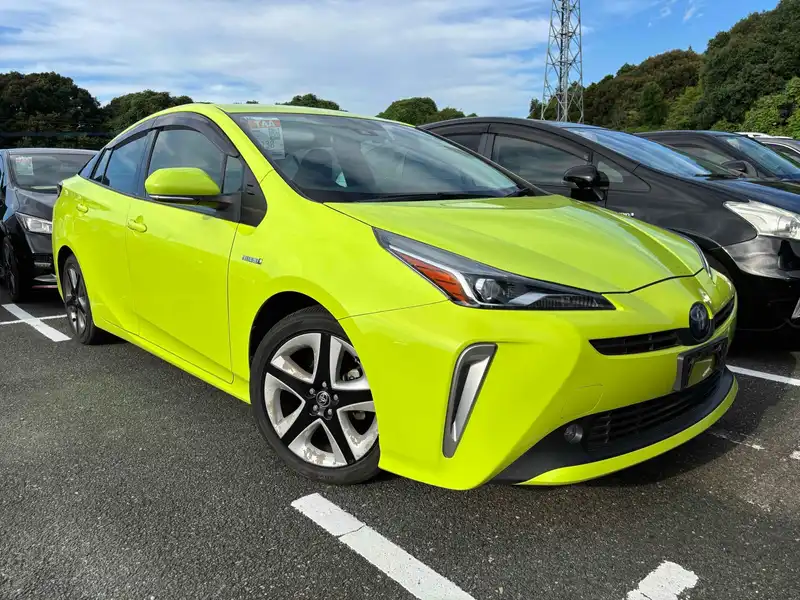 Yellow fourth-generation Toyota Prius in a Japanese vehicle lot.