The Toyota Mark X can look like an affordable executive sedan. The catch appears when you use it every day. A V6, rear-wheel drive and larger tyres do not cost the same to run as a Corolla, Fit or Aqua.
The real question is not whether the Mark X can be reliable. It is whether you can comfortably fund its fuel, servicing, suspension and import costs. This guide compares the 2.5-litre, 3.0-litre and 3.5-litre versions for Lusaka commuters and inter-town drivers.
Quick Answer
- The X130 Mark X 250G is the strongest all-round choice for most Zambian buyers.
- Toyota lists 11.8km/L for a representative late 250S on the Japanese JC08 test cycle.
- The Mark X suits paved roads and highways better than rough compounds or off-road routes.
- It offers more comfort and performance than a Corolla, but usually costs more to fuel and maintain.
- Fuel-sensitive buyers should also compare a Toyota Aqua, Corolla, Premio, Allion or Honda Fit.
What is the Toyota Mark X in Zambia?
In 2009, Toyota Global’s “Vehicle Lineage” record listed the second-generation Mark X at 4,730mm long, with a 2,850mm wheelbase. That size helps explain its calm highway ride, but it also confirms that this is a large executive sedan rather than a small commuter car. (Toyota Global, “Vehicle Lineage”, 2009)
The Mark X was sold mainly in two generations. The X120 ran from approximately 2004 to 2009, while the X130 followed from 2009 to 2019. Both used naturally aspirated V6 petrol engines, with rear-wheel drive as the main layout.
Rear-wheel drive gives the car a balanced feel on smooth roads. The long wheelbase also makes inter-town travel comfortable. However, it does not give the car extra clearance for deep potholes, rough compounds or muddy access roads.
Toyota’s official X130 data lists the 2.5-litre 4GR-FSE V6 at 2,499cc and 203PS. The late specification also uses a six-speed automatic transmission, double-wishbone front suspension and multi-link rear suspension. (Toyota Japan, “Mark X 250S Vehicle Information”, 2016)
For paved Lusaka commuting, highway travel and comfort-focused driving, the Mark X can make a lot of sense. If you need high ground clearance or the lowest possible fuel bill, it is probably the wrong starting point.
See Toyota model specifications for a broader reference when comparing engines, dimensions and equipment.
Which Toyota Mark X engine makes the most sense?
In 2009, Toyota Global recorded 2,499cc and 203PS for the X130 250G, while the 3.5-litre version produced 318PS. The 2.5-litre is therefore the sensible balance, but it remains a large upper-class V6 sedan with higher ownership exposure than a four-cylinder Toyota. (Toyota Global, “Vehicle Lineage”, 2009)
The X130 250G uses the 4GR-FSE V6. It delivers smooth acceleration, quiet cruising and useful overtaking power on the Great North Road or other paved inter-town routes. Toyota specifies regular petrol for this later 2.5-litre version.
The earlier X120 250G made about 215PS from its 2,499cc V6. The X120 300G used a 2,994cc V6 producing about 256PS. Later X130 models generally replaced the 3.0-litre engine with the 3,456cc 350-series, rated at about 318PS.
That extra performance is enjoyable, but it increases the risk of buying more car than your budget needs. Six spark plugs, more engine oil and larger tyres all matter. So does the engine capacity used in Zambia’s import-cost assessment.
| Version |
Main appeal |
Zambia ownership concern |
Buyer verdict |
| X120 250G, 2.5 V6 |
V6 comfort at the lower end of the range |
Older age and condition risk |
Consider only with strong history |
| X120 300G, 3.0 V6 |
More effortless performance |
Higher fuel and capacity exposure |
Enthusiast choice |
| X130 250G, 2.5 V6 |
Best comfort and performance balance |
Still costlier than a small Toyota |
Strongest all-round choice |
| X130 350S or 350RDS, 3.5 V6 |
Strongest output and response |
Fuel, tyres and servicing |
Poor fit for most daily drivers |
The useful distinction is simple: the 250G is the Mark X to choose with your head, while the 300G and 350-series are easier to justify with your heart. Buying a 3.5-litre car and expecting 250G running costs is where the daily habit becomes expensive.
Toyota Mark X running costs in Zambia
In 2016, Toyota Japan’s “Mark X 250S Vehicle Information” listed 11.8km/L on the JC08 test cycle. That figure is a controlled Japanese laboratory result, not a promise of Lusaka fuel consumption in traffic, heat and air-conditioning. (Toyota Japan, “Mark X 250S Vehicle Information”, 2016)
Toyota’s earlier X120 catalogue listed 12.6km/L for a 250G using Japan’s 10.15 mode. The X120 300G was listed at 11.8km/L on the same cycle. These figures should not be mixed with JC08 results as if they were directly comparable.
The 3.5-litre X130 350RDS was listed at 10.0km/L on JC08. The four-wheel-drive X130 250G FOUR was listed at 10.6km/L. Each result applies to a specific grade, drivetrain and test cycle. (Toyota GAZOO, “Mark X Catalogue”, 2009)
The bigger ownership costs often appear outside the fuel pump. Budget for six-cylinder servicing, automatic-transmission fluid, tyres, suspension bushes, control arms, shocks and cooling-system work. Modified examples may also need repairs after hard driving or drifting use.
Here is an illustrative worksheet, not an official fuel comparison. At 15,000km per year, a Mark X assumption of 10km/L uses 1,500 litres. A Corolla assumption of 15km/L uses 1,000 litres, while an Aqua assumption of 25km/L uses 600 litres.
| Vehicle assumption |
Assumed economy |
Annual fuel volume |
| Mark X 250G |
10km/L |
1,500 litres |
| Four-cylinder Corolla |
15km/L |
1,000 litres |
| Toyota Aqua hybrid |
25km/L |
600 litres |
The worksheet excludes fuel-price changes, repairs and driving style. It simply shows why the Mark X should not be budgeted like a hybrid hatchback.
Toyota Mark X prices in Zambia vary with the auction grade, mileage, engine size, exchange rate, shipping route and customs status. Do not treat an online asking price as a landed or on-road total. Before comparing prices, check whether the figure covers only the vehicle or also shipping and inspection, then budget separately for customs duties, registration and port-clearance charges.
Is the Mark X suitable for Zambian roads?
In 2009, Toyota Global listed the Mark X’s wheelbase at 2,850mm. That long distance between the axles supports stability and comfort, but it can also reduce clearance over sharp humps, broken edges and deep potholes. The car is best treated as a paved-road sedan. (Toyota Global, “Vehicle Lineage”, 2009)
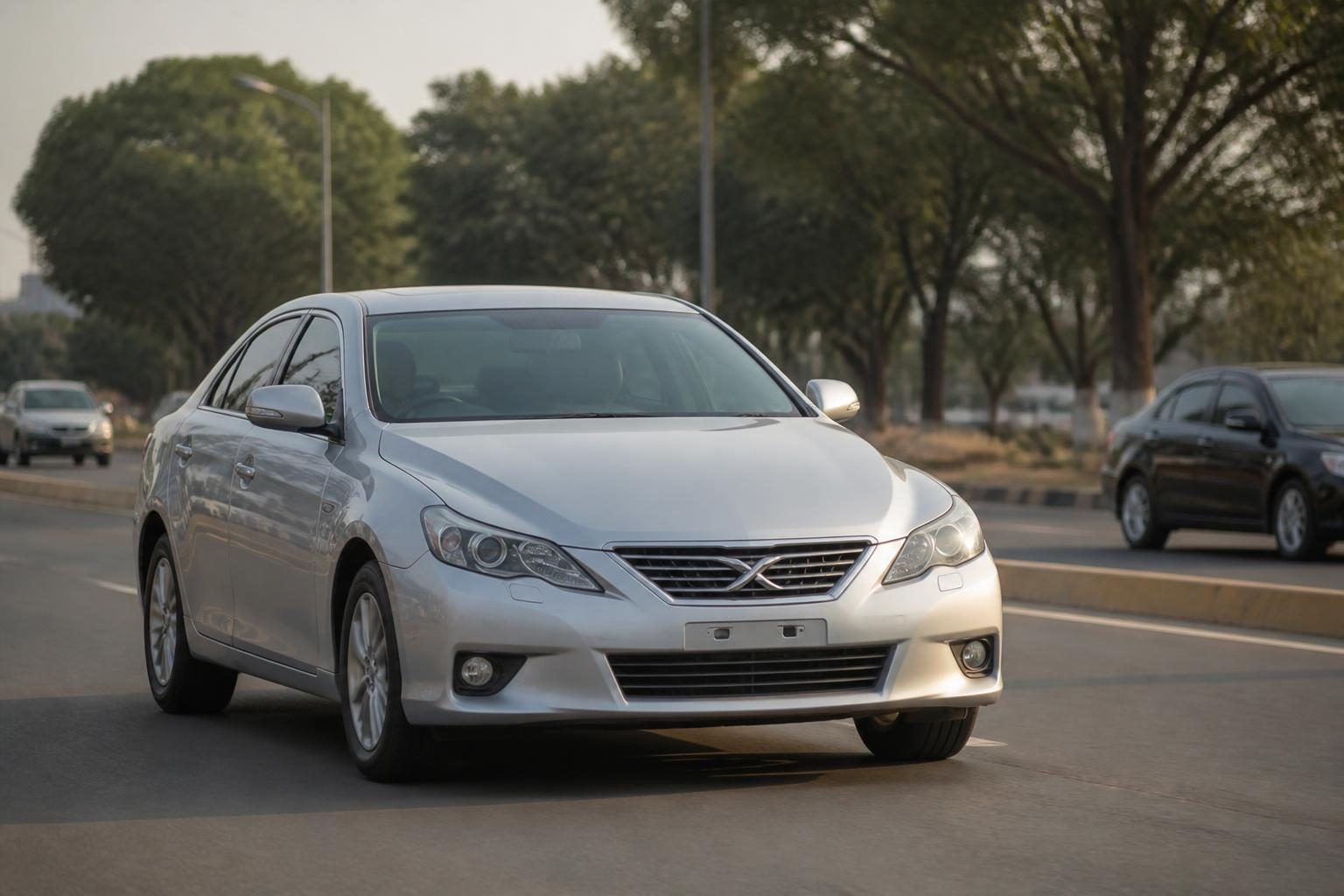 Silver sedan cruising on a calm, tree-lined city road.
The Mark X can feel composed around Lusaka and comfortable on long paved trips. Its low body, however, leaves less room for careless speed over humps. Potholes can also accelerate wear in the steering and suspension.
Rear-wheel drive is not a problem on normal paved roads. It becomes less useful on loose surfaces, mud and steep uneven access routes. The car’s comfort may encourage quicker driving, so careful speed management matters more than the performance badge.
Inspect the underside, wheel alignment and tyre wear before committing. Uneven wear can point to suspension damage, poor alignment or unsuitable modifications. A higher-clearance Toyota SUV or crossover is probably a better fit for regular rough-road use.
Compare Toyota SUVs and sedans for Zambia when rough-road clearance matters more than rear-wheel-drive handling.
What should you check before importing a Mark X?
Carbarn’s commercial import summary states that only right-hand-drive vehicles are permitted and that there is no stated vehicle age limit. Treat that page as a starting point, then confirm the current position with the relevant Zambian authorities before importing. Engine capacity, condition and current customs rules still affect the final budget. (Carbarn Zambia, “Regulations for Importing Japanese Used Cars to Zambia”, 2026)
Start with the exact model code and engine displacement. GRX120 identifies the first-generation 2.5-litre model, GRX130 the second-generation 2.5-litre, and GRX133 the second-generation 3.5-litre. Do not assume a badge tells the whole story.
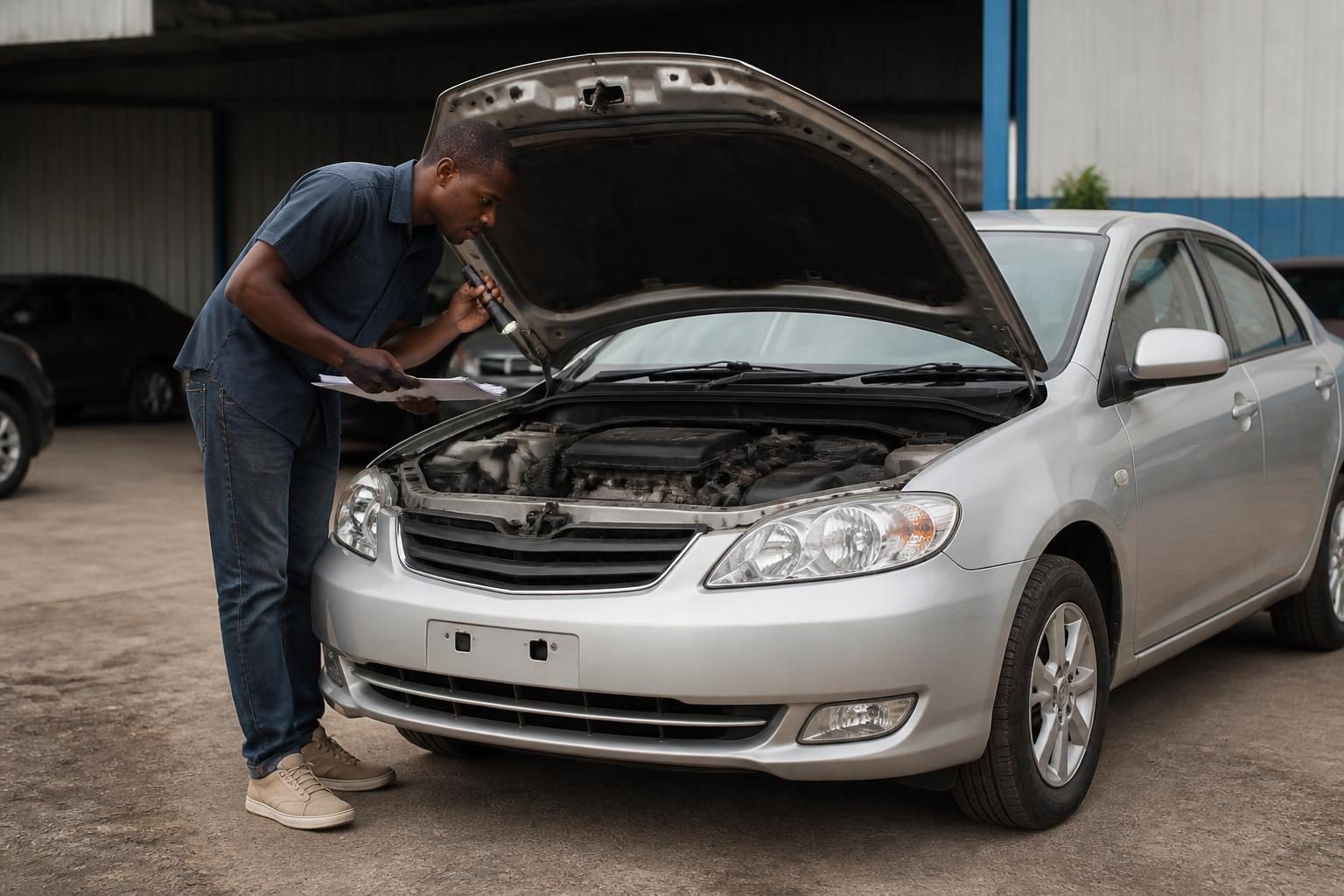 Mechanic checks a silver sedan's engine bay with the bonnet open.
Use this inspection checklist:
- Confirm the engine size, model code and drivetrain.
- Review the official Japanese auction sheet.
- Check the in-house inspection report, where supplied.
- Listen for unusual noise during a cold start.
- Check idle quality and exhaust smoke.
- Test automatic shifts when cold and warm.
- Inspect steering, alignment and suspension noise.
- Check tyres for uneven wear or oversized wheels.
- Look for accident repairs and unusual panel gaps.
- Check for coilovers, altered exhausts or drifting-related modifications.
The advertised vehicle price is not automatically the final on-road cost. Separate the vehicle, shipping and inspection charges from customs duties, registration fees and port-clearance charges. Current requirements should be checked before payment.
Toyota Crown Hybrid: A more fuel-conscious executive alternative
The current Carbarn listing for a 2018 Toyota Crown records a 2,500cc hybrid sedan with rear-wheel drive, five seats, 87,000km and auction grade 4.5. Its A25A-FXS engine and hybrid system offer a useful comparison for buyers who want executive comfort with less petrol exposure. (2018 Toyota Crown vehicle page)
2018 Toyota Crown Hybrid is not a Mark X listing. It is a comparison vehicle for the central buying decision. The Crown should appeal more to an urban commuter who spends long periods in stop-start traffic.
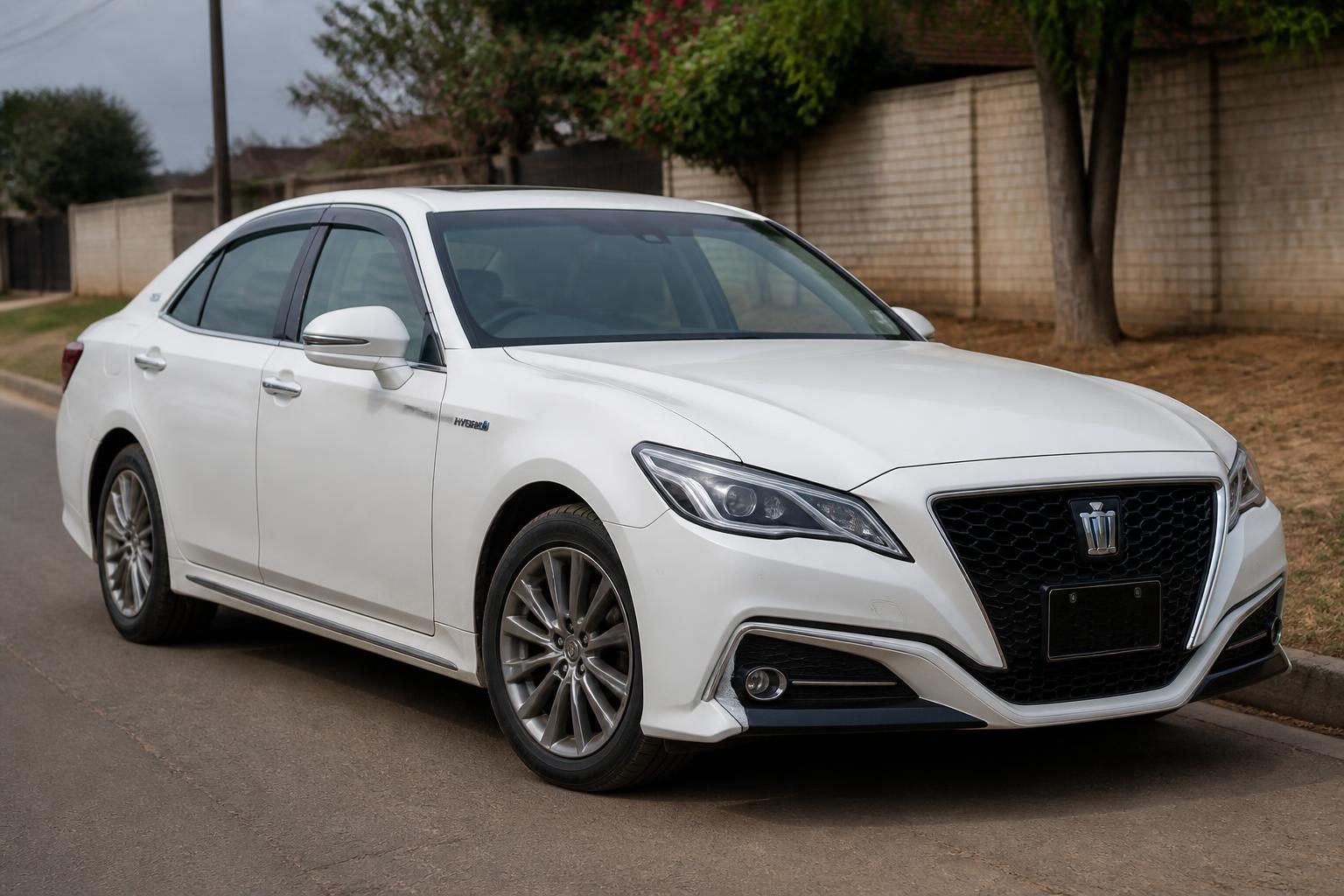 2018 Toyota Crown
The Mark X offers naturally aspirated V6 character and a more traditional rear-wheel-drive feel. The Crown offers quieter hybrid operation and a more fuel-conscious powertrain. Neither is an off-road vehicle, and both need careful checks for condition and support.
The Crown is not automatically cheaper to own in every respect. Hybrid-system condition, diagnostics and model-specific parts support still need attention. The point is fit: choose the Mark X for driving feel, or a hybrid executive sedan when traffic and fuel exposure matter more.
| Priority |
Toyota Mark X |
2018 Toyota Crown Hybrid |
| Driving character |
V6 smoothness and rear-wheel-drive balance |
Hybrid refinement and quiet urban driving |
| Fuel priority |
Weaker fit |
Stronger fit for traffic-heavy use |
| Road use |
Paved roads and highways |
Paved roads and highways |
| Main risk |
Funding V6 ownership like a small commuter |
Hybrid-system condition and support |
| Best buyer |
Comfort-focused petrol driver |
Executive commuter prioritising fuel-conscious use |
Who should buy a Toyota Mark X in Zambia?
In 2019, Toyota GAZOO still listed the X130 250G with a 2,499cc V6, six-speed automatic transmission and 11.8km/L JC08 figure. That combination makes the 250G the most balanced Mark X, but not the cheapest daily car available to Zambian buyers. (Toyota GAZOO, “Mark X Catalogue”, 2009 to 2019)
The Mark X makes sense if you mostly use paved roads, want quiet V6 power and regularly travel between towns. It also suits buyers who can fund higher fuel, tyre and servicing costs without relying on optimistic consumption assumptions.
You should probably skip it if you need the lowest possible fuel bill, drive mainly in congested traffic or regularly use rough roads. It is also a poor fit if you expect Corolla-level parts and maintenance costs.
The X130 250G is the strongest recommendation. The 3.0-litre and 3.5-litre versions suit enthusiasts with more room in their budget. A Toyota Aqua, Corolla, Premio, Allion or Honda Fit remains a better financial fit for many daily commuters.
How should a Japan-sourced Mark X be documented?
Carbarn's published process identifies Dar es Salaam as its primary port and RoRo as its shipping method. The vehicle then travels overland into Zambia, but routes vary by shipment, so the route and documents deserve the same attention as the engine and auction grade. (Zambia import guidance, “Regulations for Importing Japanese Used Cars to Zambia”, 2026)
A properly documented import should include supplier documents such as the auction sheet and condition report, together with the inspection certificate, export certificate, invoice and bill of lading. Confirm the official requirements for Interpol clearance, customs clearance and RTSA inspection and documentation before payment. Customs duties, local registration and port-clearance charges remain separate responsibilities.
The Toyota discovery page checked on September 2, 2026 did not show a Mark X model page or live Mark X vehicle listing. Inventory is dynamic, so treat the Mark X as a general import search, and compare confirmed alternatives through Toyota cars available for Zambia, Toyota model specifications and how the Japan-to-Zambia buying process works.
For a lower-fuel alternative, compare the Toyota Aqua range for Zambia.