Two compact Japanese hybrids can look similar on a Zambian import listing. Their hybrid systems, driving feel and ownership questions are quite different.
The Toyota Aqua suits buyers focused on compact Lusaka driving, fuel economy and Toyota familiarity. The Nissan Note e-POWER offers electric-motor response and a more flexible-feeling cabin. The better choice depends on battery evidence, parts support, auction grade, odometer and total landed cost.
For technical reference, compare the Toyota hybrid specifications and Nissan model details before choosing a vehicle.
Quick Answer
- Choose the Toyota Aqua for compact urban use and a familiar Toyota hybrid system.
- Choose the Nissan Note e-POWER for electric-motor response and a taller-feeling cabin.
- In 2015, Toyota listed up to 37.0 km/L JC08 for selected Aqua variants. In 2018, Nissan listed up to 37.2 km/L JC08 for the Note e-POWER S (Toyota Aqua specification PDF, 2015; Nissan Note specification sheet, 2018).
- Choose the car with better inspection evidence, battery indicators and estimated landed cost.
Toyota Aqua vs Nissan Note e-POWER at a glance
In 2026, the selected Aqua is a 2015 NHP10 with 109,000 km and grade 4, while the selected Note is a 2017 HE12 with 72,000 km and grade 4. Those differences matter because condition can outweigh small catalogue gaps (2015 Toyota Aqua vehicle page, 2026; 2017 Nissan Note vehicle page, 2026).
| Area |
Toyota Aqua |
Nissan Note e-POWER |
| Reference vehicle |
2015 NHP10 |
2017 HE12 |
| Body |
Five-seat hatchback |
Five-seat hatchback |
| Engine capacity |
1,500 cc |
1,200 cc |
| Engine power |
74 PS (54 kW) |
79 PS (58 kW) generator engine |
| Drivetrain |
Petrol-electric hybrid, FWD |
Petrol generator with electric-motor drive, FWD |
| Odometer |
109,000 km |
72,000 km |
| Auction grade |
Grade 4 |
Grade 4 |
| Main advantage |
Compact size and familiar hybrid layout |
Electric response and flexible cabin |
| Main caution |
Age and battery condition |
e-POWER-specific diagnosis |
Toyota’s official used-car catalogue lists first-generation Aqua figures from 33.8 to 38.0 km/L JC08, depending on year and grade. Nissan’s official sheet lists different Note e-POWER figures by variant, so the exact trim always matters.
Why is the Toyota Aqua a strong default for Zambia?
In 2026, the selected 2015 Toyota Aqua is an NHP10 hybrid with a 1,500 cc engine, 109,000 km, FWD and auction grade 4. It makes a lot of sense for a buyer who wants a small city car and accepts that battery evidence deserves close attention.
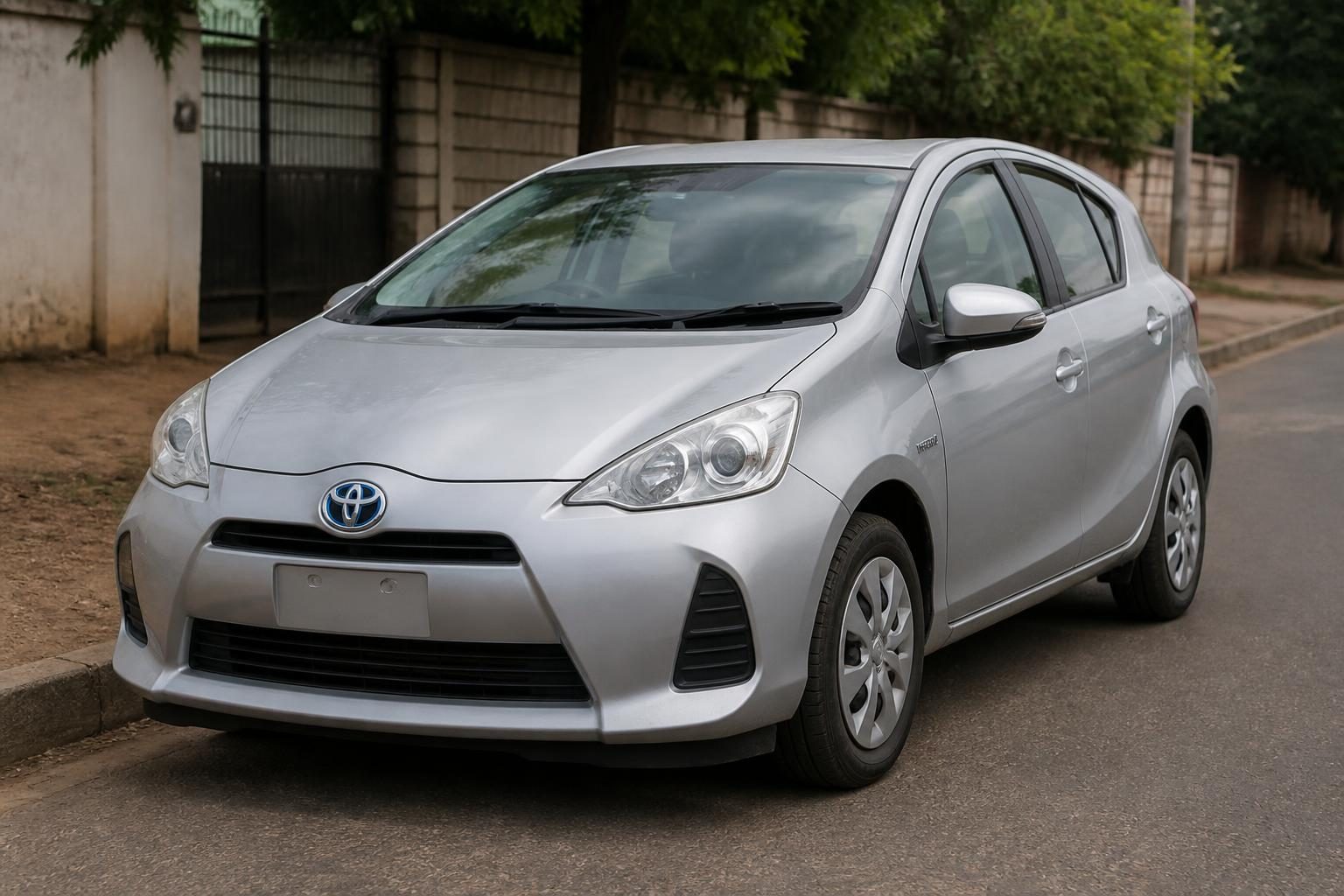 2015 Toyota Aqua
The vehicle page identifies a 1NZ-FXE engine, automatic transmission, five seats and a 3,995 mm body length. Toyota’s 2015 specification lists a nickel-metal hydride battery and up to 37.0 km/L JC08 for selected G, S and L variants (Toyota Aqua specification PDF, 2015).
That compact shape works well around Lusaka. Parking is easier, and the hybrid system suits stop-start traffic. The trade-off is space, age and ground clearance. An older Aqua can still be sensible under Zambia’s no-age-limit rule, but inspection quality matters more than the badge.
For current options, see Toyota Aqua listings in Zambia.
What makes the Nissan Note e-POWER different?
In 2026, the selected 2017 Nissan Note e-POWER is a confirmed HE12 hybrid with 72,000 km, 1,200 cc, FWD and auction grade 4. It suits buyers who want electric-motor response without plugging the car into an external charger.
The Nissan specification identifies the e-POWER system as HR12DE-EM57. The vehicle page lists HR12DE, five seats and a 4,100 mm body length. Carbarn classifies the listing as automatic, but the Note e-POWER uses electric-motor drive rather than a conventional automatic or CVT transmission. Nissan’s official Note specification describes the petrol engine generating electricity while the electric motor drives the wheels. The same sheet lists the EM57 motor at up to 80 kW and 254 Nm (Nissan Note specification sheet, 2018).
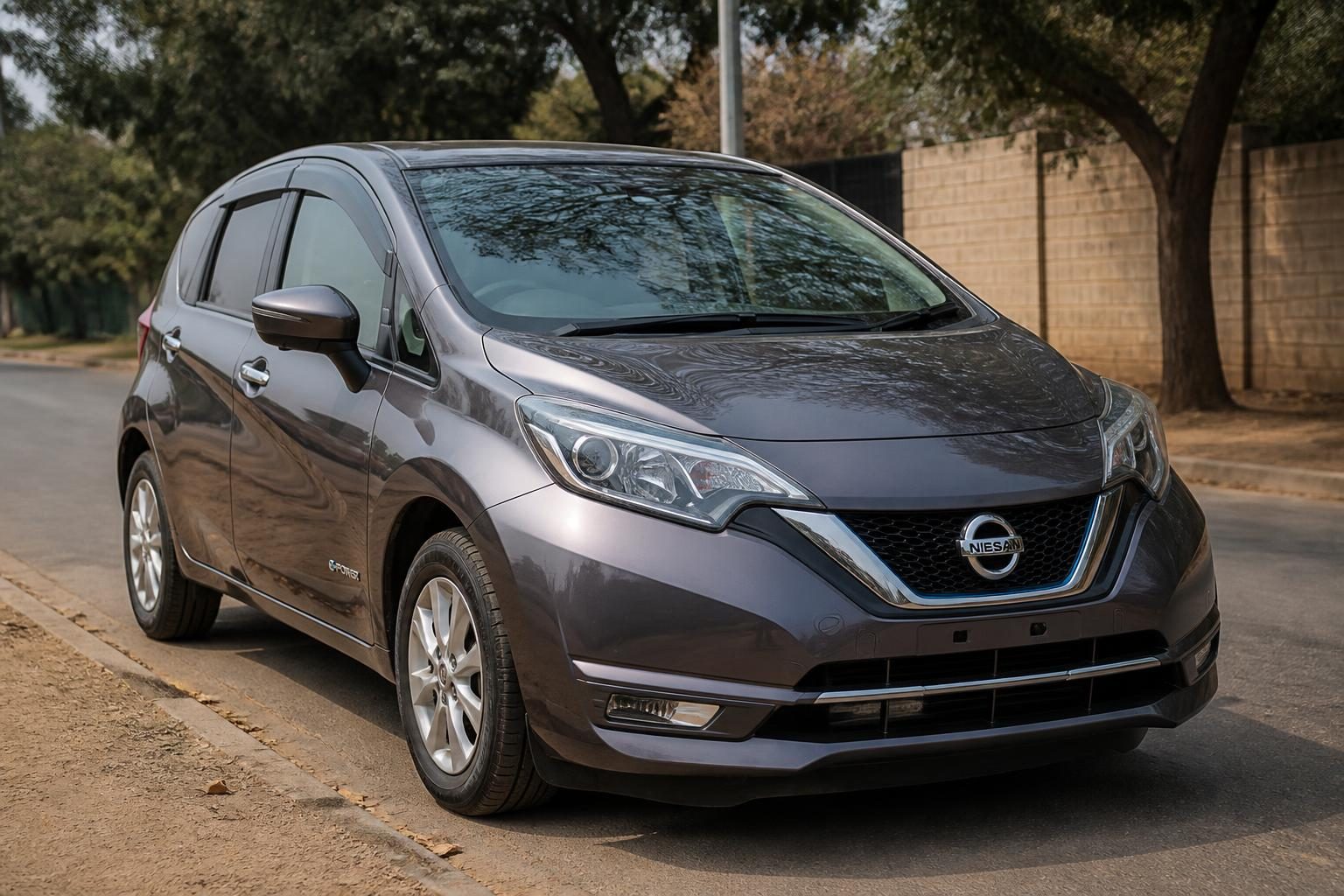 2017 Nissan Note e-POWER
The Note can feel more immediate at low speed. Its taller body also gives the cabin a more flexible feel. However, not every Nissan Note is e-POWER. A petrol Note must not be compared as though it has the same drivetrain.
For current options, see Nissan Note listings in Zambia.
Fuel economy: Aqua and Note e-POWER
In 2015, Toyota listed up to 37.0 km/L JC08 for selected Aqua variants. In 2018, Nissan listed 37.2 km/L JC08 for the Note e-POWER S. The figures are almost tied, so neither car deserves a clear fuel-economy victory from catalogue data alone (Toyota Aqua fuel catalogue, 2026; Nissan Note specification sheet, 2018).
| Variant |
Official figure |
| Nissan Note e-POWER S |
37.2 km/L JC08 |
| Toyota Aqua selected G, S and L |
37.0 km/L JC08 |
| Nissan Note e-POWER X and Medalist |
34.0 km/L JC08 |
| Toyota Aqua X-Urban |
33.8 km/L JC08 |
| Nissan Note e-POWER four-wheel drive |
28.8 km/L JC08 |
JC08 is a Japanese laboratory test. Toyota says weather, congestion, air-conditioning and driving style affect actual consumption. Lusaka traffic, passenger loads, tyre condition and longer inter-town trips will also change the result.
The 0.2 km/L gap is too small to drive the decision. Battery condition, auction grade, mileage and purchase cost deserve more weight.
How do the Aqua and Note e-POWER battery systems compare?
In 2015, Toyota’s Aqua specification described a petrol-electric system with a nickel-metal hydride battery, electric motor and electric CVT. In 2018, Nissan’s Note specification identified a lithium-ion e-POWER battery and an electric motor rated at up to 254 Nm (Toyota Aqua specification PDF, 2015; Nissan Note specification sheet, 2018).
The Aqua can use both its petrol engine and electric motor to move the car. Regenerative braking returns energy to the battery. The Note e-POWER uses the petrol engine mainly as a generator, while the electric motor drives the wheels.
 Mechanic scans an open-hood vehicle with a diagnostic tablet.
Neither system should be judged by a fixed battery-life promise. Check dashboard warning lights, battery-health evidence, cooling-fan condition, unusual engine cycling and any sudden loss of power. Compare the auction sheet with the inspection report.
The practical question is not “Which battery is better?” It is “Which exact car has better evidence?”
Which hybrid is easier to service and find parts for in Zambia?
In 2026, both reference vehicles are five-seat hatchbacks, but they use different specialist systems. Parts and service support should be checked with a local technician for the exact model code, rather than assumed from the badge or drivetrain.
Routine parts include oil, filters, tyres, brake components, wipers and 12-volt batteries. Those parts are separate from high-voltage battery assemblies, inverters, cooling fans and system-specific diagnostic equipment.
Ask a local technician whether they can diagnose an NHP10 Toyota hybrid or HE12 Nissan e-POWER system. Confirm parts by model code. If a specialist component must come from Japan, allow for transport and waiting time.
Choose the Aqua when service familiarity is your priority. Choose the Note e-POWER after confirming suitable Nissan and e-POWER diagnostic support.
Check the Toyota Aqua specifications before comparing variants.
Which one suits Lusaka and longer inter-town trips?
In 2026, the Aqua measures 3,995 mm long and the Note measures 4,100 mm, according to their respective vehicle pages. The Aqua is probably the better fit for compact urban driving, while the Note offers a slightly more flexible cabin.
Choose the Aqua if you mostly drive around Lusaka, value easy parking and prefer Toyota familiarity. It is also a sensible choice when fuel economy matters more than cabin space.
Choose the Note e-POWER if you prefer immediate electric-motor response, want a taller-feeling hatchback or are considering a newer-feeling example. Confirm technical support first.
As a practical buying judgement, neither car is the obvious fit for heavy loads, frequent full passenger use or roads where high ground clearance matters. Both are better suited to paved urban and inter-town driving, so buyers with different needs should check dimensions and carrying requirements first.
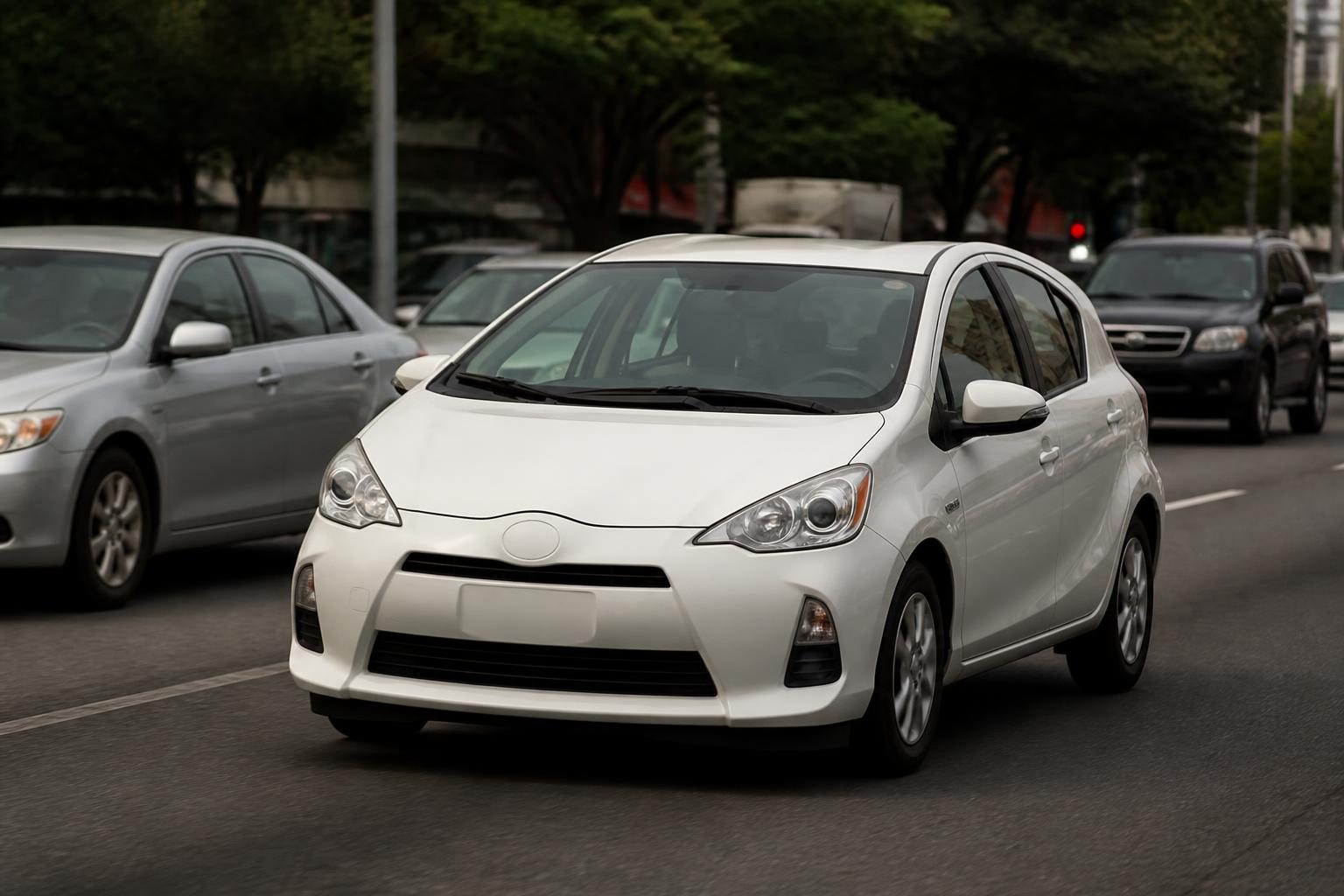 White compact hatchback travelling in busy city traffic.
Which is cheaper to import into Zambia?
In September 2026, the model pages showed changing vehicle listings rather than a stable ZMW market range. Check the current Toyota Aqua listings and Nissan Note listings, then compare each vehicle's quote, inspection evidence and estimated landed-cost panel. Prices and estimates can change as listings and import charges change.
These are changing inventory bands, not fixed quotes. An older Aqua may have the lower vehicle price but more age-related inspection risk. A newer Note may cost more while offering lower mileage or a newer cabin.
Compare the vehicle price, exact engine capacity, odometer, auction grade and inspection evidence. Carbarn's vehicle page presents estimated landed cost as the vehicle price plus applicable duties and taxes. Confirm what the current quote includes, and treat local registration and any separately identified clearance charges as additional customer costs.
Carbarn's Zambia guidance says there is no import age limit and that eligible vehicles are right-hand drive. Treat those requirements as subject to current Zambian inspection and customs rules. Import assessment depends on factors including engine capacity, age and the applicable valuation process. Check the Zambia import rules and landed-cost guidance, review current guidance from the Zambia Revenue Authority, and confirm the position before ordering.
Toyota Aqua or Nissan Note e-POWER: which should you buy?
In 2026, the official figures differ by only 0.2 km/L between selected Aqua and Note e-POWER variants. That small laboratory gap makes the better-documented vehicle more important than the model badge (Toyota Aqua fuel catalogue, 2026; Nissan Note specification sheet, 2018).
| Your priority |
Better fit |
| Compact Lusaka commuting |
Toyota Aqua |
| Familiar hybrid servicing |
Toyota Aqua |
| Electric-motor response |
Nissan Note e-POWER |
| More flexible-feeling cabin |
Nissan Note e-POWER |
| Lower advertised price |
Compare individual vehicles |
| Lower ownership risk |
Choose the better-documented car |
The Toyota Aqua is the safer default for a compact, economical city hybrid. The Nissan Note e-POWER is a strong alternative for electric response and newer-feeling examples.
Skip either car if the reports show battery warnings, accident damage, corrosion or odometer concerns.
How to compare live Aqua and Note e-POWER vehicles from Japan
In 2026, the published buying process allows buyers to review two inspection reports before payment, follow a shipment through an online dashboard and receive JEVIC certification before export. Carbarn lists the vehicles, provides the Japanese auction sheet and in-house inspection report, and ships by RoRo to Dar es Salaam before overland delivery into Zambia. The selected vehicle page describes transit to Dar es Salaam as approximately 40 days. A broader end-to-end estimate is about 6 to 10 weeks, but timing can vary and is not guaranteed. Confirm the current quote, including its estimated landed-cost panel and any separate local charges. Compare the Toyota Aqua reference vehicle, Nissan Note reference vehicle, buying process and import rules before payment.